Keep Your Air-Con Unit Running Trouble Free
August 14, 2019
Get The Right Air Conditioner For Your Home
August 14, 2019Tips On Using Air Cons At Home

Regular cleaning of your air con filter helps improve performance and air quality at home.
To avoid potential problems with your air cons, here are some tips. Know the good change in temperature of an air con (frequent change in temperature brought by an air con unit is 20 degrees). To avoid overworking your group, make sure to change its filters four times a year. This would ensure that the air coming out of the unit is fresh and safe for you and your family. This would also help in saving your energy consumption at home. An air con unit could sometimes ice up or freeze on its drain line. This sometimes causes leaks. The best solution for this is to turn off the compressor. You can do this by switching the thermostat to the fan mode. Make sure to prepare any material that you can use as drainage once the ice melts.
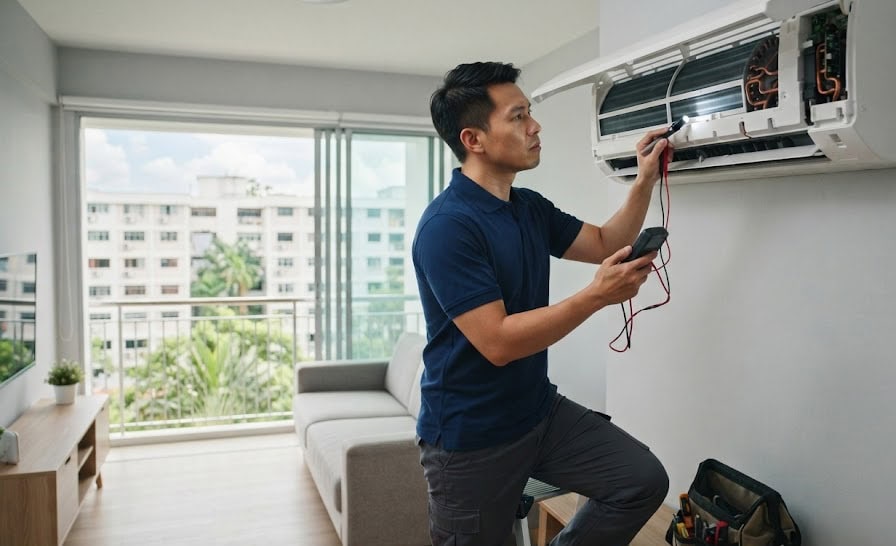
An air con unit can have problems with its airflow. There are several causes, and you won’t be able to figure this out on your own. The best thing to do is call a professional. There may be problems with the coils, the ductwork, or other parts. Only an expert could check them and find what causes the problem. For your unit installed outdoors, make sure to plant trees that will serve as shade to it. This allows it to perform better, probably 10% better than usual. Using trees or shrubs as shade would keep your unit cooler. But remember not to keep them too close so as not to prevent it from being cleaned or serviced by a technician.
To avoid problems on your air cons, make sure to have it checked at least once a year. Regular checkups would help in keeping the unit fully functioning. Tune-ups would reduce the risks of having a malfunctioning unit. To ensure that your unit is regularly maintained, you could ask a company to provide a service agreement for you. This way, you’ll be assured that your unit stays in good condition year-round.
How To Choose The Right Air Con Unit
Face it central air conditioning is very expensive. If your home doesn’t already have it, it is not likely that it ever will, that is unless you have the thousands of dollars needed to have the work done, which includes tearing out your walls and losing some ceiling space if the crawl space doesn’t already exist. While for many people central air would be preferable, if it is not affordable then it simply is not an option. That doesn’t mean that you need to go without clean air, however. A professional air con company provides you with alternative methods for cooling your home or office. These methods include wall units, window units, portable units or even ceiling units. Choosing the right unit is important in order to get the most from your air conditioning. You do not want to choose a unit that is designed for a 300 square foot room, for example if you have a 500 square foot room.
One of the ways to determine which air con unit is right for you and your situation is to walk through your home or business and assess just how much space needs to be air conditioned. It is important to note that in most cases, these small units are not designed to cool more than one room. The exception being very open smaller spaces, such as a small combined kitchen and living room. Once you have determined how much square footage you want to cool, then it is time to talk with a professional.
The experts at an air con company can help you make the rest of your decisions about what units you should purchase for your home or business.
The Air Con Advantage
Air conditioning has been available to most homes for decades and has allowed the indoor environments of home, work, and school to become more comfortable. The ability of an efficient air con system to move air quickly through the system and back to the living space is important if the effects of the system are to be fully realized. Depending on the type of unit used by your home or office, the air is circulated in various ways. In the most traditional of air conditioning systems, warm air is removed from your home and then taken to the evaporator which is located near the blower assembly inside the home. As the warm air moves past the evaporator coils it is cooled while the energy from the air is transported to the coils and circulated to the condenser unit outside the home. As long as the evaporator coils continue to cool the air being circulated past them, the air returning to your home should be cooler than the air that was taken in only moments earlier by your system. However, any blockage of airflow or problems with the evaporator coils or condenser can cause a loss of system efficiency.
When you notice the air returning to your home is not as cool as expected, it is time to call a Singapore air conditioning company for a possible aircon repair. There is a list of potential problems with your system when it is no longer functioning as expected. For one, if the blower is unable to pull warm air from your home into the ventilation ducts, the air cannot be cooled. Check to see if there is any blockage of the air intake or filter before making a phone call to the service technician. If someone in the home has inadvertently blocked the intake by placing something in front of it, the result will be loss of airflow and a decrease in active cooling.
The evaporator coils can become corroded and begin to leak refrigerant from the system. Having a yearly aircon servicing of the unit will normally allow a service technician the opportunity to test for such leaks here as well as in the unit outside. Any leak will decrease the system pressure and practically eliminate any capability your system once had for cooling the air efficiently. If a leak is found it may be repaired quickly in most cases. However, if the leak is large or if the service technician deems the evaporator or condenser a complete loss, the part may have to be ordered before the technician can perform the necessary repairs.
The compressor must have refrigerant in order to sufficiently force coolant through the lines and aid in the cooling process. In some cases, the compressor may stop operating efficiently or may quit operating entirely. Without this piece of equipment, the air con system will fail to cool your home. Of all the parts of your system, the compressor is the most expensive and difficult to deal with and its demise will require the replacement of the entire outdoor portion of the unit. This and other parts of the system must be maintained annually to avoid potentially expensive replacement costs.
Basics Tips Before An Air Conditioner Repair
Model Partition Of An Air Conditioner
An air conditioner has 2 different working parts on which it actually operates. These are the evaporator and the condenser. While the condenser of an air conditioner is placed outside the room or location where it is used, the evaporator is placed inside the main cabinet of the air conditioner.
Most people connect their air conditioners to the air distribution system, and they share a common motor, ductwork, and blower for both heating and throwing cold air outside. Home air conditioning repairs are not a one-time activity, as you would need to perform it all throughout the life of the air conditioner, so knowing the technical operations of an air conditioner is of utmost vital.
When you switch on the air conditioner, the hot air present in the room is sucked and channeled to the furnace with the help of the return channel. The hot air then moves to the evaporator coils present in the plenum, which direct it towards the cooling house. Plenums are special coils for air movement and ventilation. The operation of an air conditioner depends on the plenum, which facilitates airflow. So, if your air conditioner isn’t cooling the room, it’s probable that it has a problem in its air outlet channel or plenums.
While do-it-yourself service is possible for minor faults in an air conditioner, for major faults or breakdowns, you should call a technician for serious home air conditioning repairs. Cleaning of the evaporator and other menial tasks could be performed by you, but make sure you do not have a go at something you are not adept at.