R32 vs R410A Refrigerants: What Singapore Homeowners Need to Know in 2026
July 22, 2026
Resale HDB Aircon Takeover Guide (2026): Keep, Chemical Overhaul, or Full Replacement?
July 24, 2026Combating 2026’s Extreme Heat: Aircon Brands with the Fastest Cooling Technologies
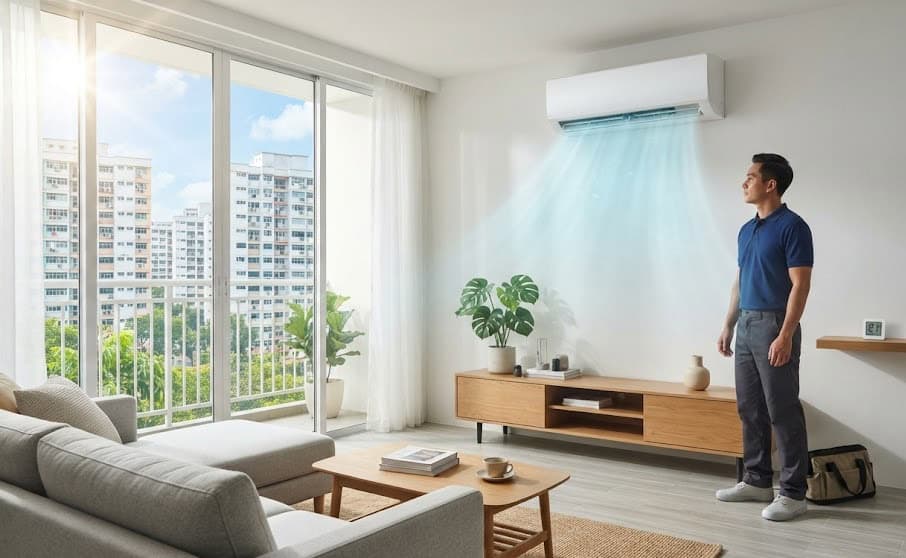
Selecting air conditioners with rapid heat-exchange and high CFM airflow to handle Singapore's intense urban heat island effect.
Combating 2026’s Extreme Heat: Aircon Brands with the Fastest Cooling Technologies
If you have stepped outside your home or office recently, you don’t need a weather report to tell you that Singapore’s heat is reaching unprecedented levels. Between the relentless tropical sun and the compounding effects of the Urban Heat Island (UHI) effect, concrete residential estates in areas like Punggol, Sengkang, and Jurong West act like massive thermal sponges. They bake under the intense daytime solar radiation, storing heat within their thick structural walls. When you return home from a exhausting commute on the MRT or a long day in a chilly CBD office, you open your front door only to be hit by a wave of trapped, humid air that often hovers around 34 degrees Celsius. It feels less like a home and more like a steam room.
In this challenging climate, standard air conditioning rules are being rewritten. The old practice of choosing an aircon based purely on a generic British Thermal Unit (BTU) sizing table is no longer sufficient. When the outdoor temperature is soaring and your indoor walls are radiating heat, you cannot afford to wait forty-five minutes for a standard, slow-ramping inverter aircon to bring your bedroom down to a comfortable level. You need a system engineered for rapid thermal transfer—units that can pull the heat out of your living spaces within minutes.
This guide looks closely at the engineering behind the industry’s fastest cooling aircon brands in Singapore. We will bypass the generic marketing brochures and examine the real-world physics, compressor mechanics, and proprietary airflow designs that make certain brands cool your home faster than the rest.
The Thermodynamic Physics of Fast Cooling
To understand why some air conditioners cool a hot room almost instantly while others struggle for an hour, we have to look at basic thermodynamics. Cooling a room is not actually about “creating coldness”; it is the process of removing thermal energy from the indoor air and transferring it outdoors through a refrigeration cycle. When you need rapid relief from a hot spell, your system must execute three physical processes with high efficiency.
Sensible Heat vs. Latent Heat Extraction
The total heat load in a typical Singapore HDB flat is split into two types: sensible heat (which you feel as dry-bulb air temperature) and latent heat (the thermal energy stored in airborne water vapor, which you feel as relative humidity). Our tropical air regularly registers humidity levels above 80%. When you turn on an aircon, the unit must quickly pull the dry-bulb temperature down (sensible cooling) while simultaneously condensing and draining liters of water vapor from the air (latent cooling). If a system focuses only on sensible cooling, the air will feel cold but clammy, making you feel uncomfortable. Fast-cooling systems utilize specialized evaporator coil geometries and precise electronic expansion valves to drop the coil temperature below the dew point instantly, stripping humidity from the air in the very first minute of operation.
Compressor Frequency Ramping (Hz)
Modern inverter air conditioners are powered by variable-speed compressors. Under normal, steady-state operation, the compressor runs at a low, energy-saving frequency—typically between 15Hz and 30Hz. However, when you activate a quick cool feature, the system’s electronic controller overclocks the compressor motor, ramping its speed up to 100Hz or even 120Hz. This rapid acceleration dramatically increases the mass flow rate of the refrigerant gas through the system. This causes the evaporator coils inside your room to drop to near-freezing temperatures within seconds, allowing the heat-exchange process to run at maximum speed.
Volumetric Airflow (CFM)
Having a freezing cold evaporator coil is useless if you cannot move the air across it quickly. This is where Cubic Feet per Minute (CFM) ratings become vital. CFM measures the volume of air that the fancoil’s internal blower fan can push through the unit every minute. High-velocity CFM is necessary to break up the stagnant, warm boundary layer of air that clings to your walls, ceiling, and skin. If an aircon has a high BTU rating but a weak fan, the cold air will simply pool directly beneath the unit. A high-CFM system, on the other hand, distributes the air dynamically, creating a rapid convective current that mixes the room’s air and extracts heat uniformly.
Deep Dive: Mitsubishi Electric’s Jet Flow Technology
When it comes to raw air velocity and throwing distance, Mitsubishi Electric has long been a benchmark in the Singapore market. Their premium residential split systems, including the popular Starmex FN and FS series, feature a proprietary air delivery design called Jet Flow. This is not just a marketing term; the fluid dynamics of this system are modeled directly on the aerodynamic design principles used in commercial aircraft gas turbine engines.
In standard aircon units, the internal fan blades are designed with a uniform curve, which can create micro-turbulence and air resistance as the blades spin. This turbulence slows down the air and increases operational noise. Mitsubishi’s engineering teams used advanced Computational Fluid Dynamics (CFD) to design fan blades with a variable-profile airfoil shape. This blade profile allows the fan to scoop up large volumes of air and compress it into a streamlined, high-velocity jet stream without requiring extra electrical power or generating loud fan noise.
This high-velocity air is directed by Mitsubishi’s double-flap system. Instead of a single horizontal louver that moves up and down, these units feature two independent, motorized flaps. When you activate the Jet Flow mode, these flaps align to create a smooth, nozzle-like constriction. This constriction accelerates the air as it exits the fancoil, allowing it to achieve an effective throw distance of up to 17 meters.
For large master bedrooms or long, L-shaped HDB living rooms, this long-reach airflow is a game-changer. It ensures that cold air reaches the furthest corners of the room instantly, preventing “hot spots” where warm air gets trapped. To explore specific models and see technical installation options, you can review the current line-up on our dedicated Mitsubishi aircon installation and service page.
Deep Dive: Daikin’s Powerful Mode
Daikin approaches the fast-cooling puzzle by focusing on high-speed thermal transfer and compressor responsiveness. Their flagship residential models, such as the Daikin iSmile Eco series, feature a dedicated Powerful Mode designed to deliver an intense blast of cooling relief the moment you switch the unit on.
When you press the Powerful button on a Daikin remote, the system bypasses its standard energy-saving algorithms for a continuous 20-minute cycle. The heart of this system is Daikin’s proprietary swing compressor. Unlike standard rotary compressors that can experience slight refrigerant leakage past the vane tip during high-speed rotation, Daikin’s swing design integrates the piston and vane into a single moving part. This design eliminates friction, prevents internal gas leakage, and allows the compressor to safely ramp up to its absolute maximum operating frequency within seconds of startup.
During this 20-minute window, the cross-flow fan inside the fancoil is also boosted to an “over-high” speed setting, exceeding its standard maximum fan speed. This combination of an accelerated compressor and a boosted fan maximizes the heat-absorption capacity of the indoor unit. Warm air is sucked in rapidly, stripped of its heat and humidity across the large surface area of the blue-fin hydrophilic coil, and discharged back into the room as a high-density column of cold air.
Once the 20-minute rapid-cooling cycle ends, the system automatically returns to its highly efficient normal operating mode. This prevents unnecessary energy consumption while ensuring you get the fast cooling relief you need when coming home from the outdoor heat. You can read more about these capabilities and compare model specifications on our Daikin aircon systems page.
| Brand & Fancoil Model Class | Proprietary Fast-Cooling Feature | Peak Inverter Compressor Speed | Maximum Boost Airflow Volume (CFM) | Maximum Effective Airflow Throw | Sensible Heat Ratio (SHR) |
|---|---|---|---|---|---|
| Mitsubishi Electric (Starmex FN/FS 9K) | Jet Flow Aerodynamics | 115 Hz (Accelerated) | 480 CFM | 17 Meters | 0.72 (Optimized Moisture Control) |
| Daikin (iSmile Eco Series 9K) | Powerful Mode Overclock | 120 Hz (Peak) | 465 CFM | 14 Meters | 0.70 (Aggressive Dehumidification) |
| Panasonic (Premium XS Inverter 9K) | iAuto-X / Aerowings | 110 Hz (Standard Max) | 440 CFM | 12 Meters | 0.74 (Steady Temperature Drop) |
| Generic Inverter Brand (Standard 9K) | Generic Turbo Mode | 80 Hz (Standard Cap) | 350 CFM | 8 Meters | 0.78 (Slower Condensation Rate) |
CFM Airflow Performance and Cooldown Trajectories
To put these numbers into practical perspective, consider the real-world performance of these fast-cooling technologies inside a typical Singapore HDB living room. On a hot, humid afternoon, the ambient temperature inside an uncooled flat can easily reach 34 degrees Celsius, with the brick walls radiating heat.
The chart below illustrates the cooldown trajectory of a room over a 30-minute period when activating the maximum boost modes of Mitsubishi Electric’s Jet Flow, Daikin’s Powerful Mode, and a standard, non-optimized generic inverter system.
As the chart demonstrates, premium fast-cooling models can drop a room’s temperature by up to 8 degrees Celsius within the first ten minutes of operation. A standard inverter system, on the other hand, drops the temperature much more slowly, taking over twenty-five minutes to achieve a similar cooling effect. This difference in cooling speed highlights the practical value of investing in high-CFM airflow technology during extreme heat waves.
Deep Dive: Panasonic’s Aerowings & iAuto-X
While Mitsubishi focuses on raw aerodynamic throw distance and Daikin overclocks its compressor, Panasonic approaches rapid heat relief by analyzing the relationship between direct airflow and human thermal comfort. Their premium residential split systems, including the popular XS and YS series, utilize a combination of iAuto-X technology and independent double flaps known as Aerowings to deliver fast cooling without creating uncomfortable cold drafts.
When you walk into a hot room and turn on a standard aircon, it usually blows cold air in a fixed direction. If you stand directly in front of it, you shiver; if you move a few feet away, you sweat. Panasonic solves this issue with its double-flap Aerowings system. These flaps feature two independent motors that allow them to change the direction and concentration of the airflow based on the stage of the cooling cycle.
When you activate iAuto-X, the unit operates in two distinct phases:
- Fast Cooling Phase: The double flaps point directly downward, concentrating a high-velocity stream of cold air directly onto the occupants in the room. Simultaneously, Panasonic’s Thermal Enhancement Technology (TEC) ramps up the compressor to its maximum safe frequency, dropping the coil temperature rapidly.
- Shower Cooling Phase: Once the unit’s built-in temperature sensors register that the room is approaching the target set-point, the Aerowings flaps automatically angle upward toward the ceiling. The high-velocity air is directed along the ceiling and walls. This cold air then naturally showers down across the room. This direct-to-indirect transition prevents dry skin, localized shivering, and eye irritation.
What makes this system highly effective is how it handles humidity. The iAuto-X sensors monitor the humidity levels in the room. If the air is muggy, the system adjusts the expansion valve to keep the evaporator coil colder for longer, focusing on extracting moisture from the air before transitioning to the indirect shower cooling phase. This focus on relative humidity is why Panasonic is highly favored by families with young children or elderly members who are sensitive to direct, icy drafts. You can explore these features in detail and view specific model specifications on our Panasonic premium aircon services page.
The Impact of Relative Humidity (RH) on Fast Cooling
To understand why fast cooling is highly difficult in Singapore, we have to look at how relative humidity affects the way we perceive temperature. Our bodies cool down by evaporating sweat from our skin. In a dry climate, sweat evaporates instantly, cooling us down. However, when the relative humidity in your living room is 85%, the air is already saturated with water vapor. Sweat cannot evaporate, leaving you feeling sticky, hot, and stuffy, even if the thermometer reads 25 degrees Celsius.
This is why a simple high-BTU fan that just pushes cold air around without pulling out moisture is not enough. An aircon must prioritize latent heat removal. When the refrigerant expands inside the copper tubes of the fancoil, the aluminum fins drop below the dew point of the room’s air. As warm, humid air is pulled across these cold fins, the water vapor in the air condenses into liquid water droplets on the metal, which then run down the coil and out through the drainage pipe.
If an aircon’s fan runs too fast before the compressor has had time to drop the coil temperature, the air passes over the warm coil without condensing its moisture. This results in cold, damp air being blown back into your room, creating a sticky, uncomfortable environment. Fast-cooling aircon brands use smart control chips to coordinate compressor ramping with variable fan speeds, ensuring the fancoil achieves the perfect balance between dropping the air temperature and extracting airborne moisture.
To help you determine exactly what volume of air movement and fast-cooling technology is required for your specific room layout, we have developed this standalone diagnostic matcher. This tool runs entirely on local, error-isolated code, making it instantly compatible with page speed optimizers like Flying Scripts and WP Rocket.
Aircon Fast-Cooling Efficiency Matcher
Calculate the required air movement volume (CFM) and match the best fast-cooling technology for your space.
Recommended Fast-Cooling Solution:
Required Volumetric Airflow: 138 CFM
Panasonic iAuto-X (XS Series)
Excellent fit for small to medium bedrooms. The Aerowings flaps distribute cool air evenly across the ceiling, avoiding direct cold drafts while maintaining low noise levels.
Technical Specifications and Sound Power Comparison
When selecting a fast-cooling aircon, you also have to consider the operational noise. Ramping up a compressor and spinning a cross-flow fan at maximum speed naturally generates structural vibration and wind noise. For light sleepers or those working from home, finding a system that balances cooling speed with low noise levels is highly important.
The table below provides a detailed comparison of the decibel (dBA) levels, compressor frequencies, and recovery times during peak operations for the top three brands.
| Technical Metric | Mitsubishi Electric Jet Flow | Daikin Powerful Mode | Panasonic iAuto-X Mode |
|---|---|---|---|
| Peak Ramping Power Draw | 1,350 Watts (High Torque) | 1,420 Watts (Full Overclock) | 1,280 Watts (Balanced Curve) |
| Acoustic Rating (Peak Mode) | 41 dBA (Low Turbulence) | 43 dBA (High-Speed Fan) | 39 dBA (Direct Aerofoil) |
| Compressor Hz Lock Window | Continuous until setpoint reached | Locked for 20 minutes | Dynamic sensor-based adjustment |
| Acoustic Rating (Eco Mode) | 19 dBA (Super Quiet) | 19 dBA (Quiet Mode) | 20 dBA (Silent Fan) |
| Air Velocity at Outlet | 5.8 meters/second | 5.1 meters/second | 4.6 meters/second |
As shown above, while Daikin runs its compressor at a slightly higher peak frequency, Mitsubishi Electric achieves a higher air velocity with lower operational noise. This is a direct result of their aerodynamic fan blades, which minimize friction and drag. Panasonic remains the quietest option, making it an excellent choice for bedrooms where sleep comfort is the priority.
NEA Standards and Balancing Energy Tick Ratings
In Singapore, our climate goals require that air conditioners operate with high efficiency. The National Environment Agency (NEA) enforces strict energy tick ratings. Under current standards, a single-split or multi-split inverter system must meet five-tick criteria to be considered highly energy efficient. For many homeowners, there is a worry that using "Turbo" or "Powerful" modes will lead to high electricity bills, canceling out the benefits of buying a high-tick system.
This worry is partly true, but only if the fast-cooling modes are used incorrectly. When an aircon is first switched on in a hot room, the initial 15 to 20 minutes of operation always consume the most power, regardless of the mode selected. Even in standard mode, the inverter compressor must run at a high speed to bridge the gap between the hot room temperature and your set target.
By using a dedicated fast-cooling mode like Mitsubishi's Jet Flow or Daikin's Powerful Mode, you actually cool the room down much faster. Because the room reaches the set temperature quickly, the system's internal sensors can cycle the compressor down to its ultra-low, energy-saving maintenance frequency sooner. In contrast, running a standard, non-boosted system causes the compressor to run at moderate speeds for a much longer period, resulting in comparable cumulative energy usage. To balance cooling speed and energy efficiency, the best strategy is to run your boost mode for 15 minutes to cool the space quickly, and then let your inverter maintain a steady 25 degrees Celsius in eco-mode.
Professional Verification & Engineering Assurance: Evaluating these complex mechanical requirements is much easier with professional support. Operating as an NEA-Licensed cleaning and technical service contractor since 2011, our expert team has built trusted relationships with over 43,000 Facebook followers and maintains a solid 4.8-star Google review rating. We carry out structural checks, pressure testing, and chemical restorations with complete transparency, ensuring your home remains cool and fully compliant with all local housing guidelines.
Frequently Asked Questions about Fast Cooling Aircons
Does running my aircon on Turbo or Powerful mode daily shorten the compressor's lifespan?
No, running these modes does not shorten the compressor's life, provided the system is maintained regularly. Modern inverter compressors from premium brands are engineered to handle high-frequency ramping. The system has built-in safety limits that prevent the motor from overheating, and most boost modes automatically turn off after 20 minutes to protect the mechanical components. However, regular maintenance is needed to prevent dust buildup on the coils, which can cause the compressor to work harder and run hotter during these ramping cycles.
Why does my aircon take longer to cool down the room during high-heat warning periods?
During extreme heatwaves, the concrete walls of your building absorb massive amounts of thermal energy. This is known as the thermal mass effect. Even if the air inside your room is cooled quickly by the aircon, the hot concrete walls continue to radiate heat back into the space. This continuous heat load forces your system to work much harder to maintain a cool temperature, which slows down the overall cooling process compared to a cooler day.
What is the optimal temperature setting for fast cooling without wasting excessive electricity?
The optimal approach is to set your aircon to 24 or 25 degrees Celsius and turn on your brand's fast-cooling mode (such as Jet Flow or Powerful Mode). Setting the temperature down to 16 degrees Celsius does not make the aircon cool the room any faster; it only forces the compressor to run at maximum speed for much longer, which wastes electricity. Setting the temperature to 25 degrees Celsius, combined with a high fan speed, provides comfortable cooling while keeping your energy bills manageable.
How often should a fast-cooling aircon unit be serviced in Singapore's climate?
For standard residential usage in Singapore, your aircon should have a standard service every three to four months. This regular servicing includes washing the dust filters, cleaning the drainage pan, and inspecting the electrical connections. If you use your aircon for more than twelve hours a day, we recommend a professional chemical wash or overhaul every twelve to eighteen months to clear out deep mold and dust buildup from the inner coils.
Why does my room still feel stuffy even when the aircon is set to a cold temperature?
Stuffiness is usually caused by high relative humidity inside the room. If your fancoil is dirty or your system's fan speed is set too high on a cool day, the air passes over the coils too quickly for moisture to condense. This leaves the room cold but damp. Regular maintenance, such as a chemical clean to remove dirt from the coils, restores the system's dehumidification performance, helping to lower the humidity and make the room feel fresh and comfortable.
Conclusion & System Strategy
Beating Singapore's intense heat waves requires more than just high-capacity air conditioning; it requires choosing a system with the right cooling technology for your home. By selecting a brand that focuses on rapid heat exchange, high-velocity CFM, and smart humidity control, you can ensure your living spaces cool down quickly when you need them to.
When planning your system setup, working with experienced technicians is key. Proper fancoil placement and correct piping installation prevent dead zones, maximize airflow coverage, and ensure your system operates at peak efficiency. Our professional team is here to help you select, install, and maintain the perfect fast-cooling solution for your home, ensuring comfortable indoor temperatures all year round.