Smart Aircons in 2026: Using Wi-Fi Apps to Track and Lower Cooling Bills
July 21, 2026
Combating 2026’s Extreme Heat: Aircon Brands with the Fastest Cooling Technologies
July 23, 2026R32 vs R410A Refrigerants: What Singapore Homeowners Need to Know in 2026
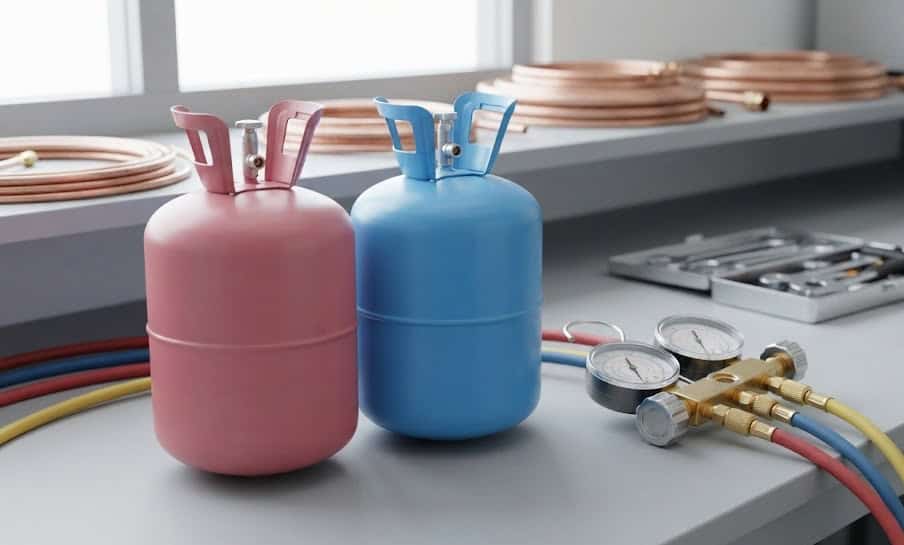
Evaluating the thermophysical differences, cooling efficiencies, and top-up dynamics of R32 and R410A refrigerants inside Singaporean households.
R32 vs R410A Refrigerants: What Singapore Homeowners Need to Know in 2026
If you are collecting the keys to your new BTO flat or planning a complete renovation of a resale HDB unit, your contractor or interior designer has likely asked you a vital question: “Do you want an R32 or R410A aircon system?” For many Singaporeans, refrigerant gas is something invisible that sits inside the outdoor compressor. It is easy to ignore until your system stops blowing cold air and you are hit with an expensive bill for a gas top-up.
In this current year, Singapore is undergoing a major shift in residential climate control. Environmental regulations are actively phasing out high-emission greenhouse gases, making the choice of refrigerant a key decision for your household. Buying an aircon is a long-term investment, and selecting an obsolete gas type today can lead to high maintenance costs, scarce replacement parts, and expensive top-up fees down the road.
This guide analyzes the technical and practical differences between R32 and R410A. We will examine how these gases behave under pressure, how they impact your monthly electricity bills, and what you need to look out for during installation to future-proof your home against rising temperatures.
The Technical Evolution of Aircon Gas
To understand why the industry is moving away from R410A, we have to look at the history of residential refrigerants. Air conditioning works by circulating a chemical gas that changes state from liquid to vapor as it absorbs and releases heat. Over the last few decades, the chemical makeup of this gas has changed repeatedly as environmental science has evolved.
The Legacy of R22
Up until the early 2000s, almost every residential aircon in Singapore used R22, a chlorofluorocarbon (HCFC) gas. While R22 was an excellent heat-transfer medium, it contained chlorine, which actively destroyed the earth’s ozone layer. Under global environmental treaties, R22 was phased out. Today, finding R22 gas is incredibly difficult, and a basic top-up for an old R22 system can cost hundreds of dollars, forcing most homeowners with these legacy units to scrap their entire system when a leak occurs.
The Rise and Fall of R410A
To replace R22, chemical manufacturers developed R410A, a hydrofluorocarbon (HFC) blend. R410A has zero ozone depletion potential, which was a massive step forward. For the past fifteen years, it has been the dominant gas used in System 3 and System 4 inverter air conditioners across Singapore. However, R410A has a major hidden flaw: it possesses an exceptionally high Global Warming Potential (GWP) of 2,088. This means that if one kilogram of R410A gas leaks into the atmosphere, its greenhouse warming effect is equivalent to releasing over two metric tons of carbon dioxide. Because of this high environmental footprint, global and local standards are now phasing out R410A in favor of cleaner alternatives.
The New Standard: R32
The current state-of-the-art refrigerant for residential systems is R32, chemically known as difluoromethane ($CH_2F_2$). Unlike R410A, which is a blend of two different gases, R32 is a pure, single-component refrigerant. It has a GWP of only 675—which is two-thirds lower than R410A. Additionally, R32 is highly efficient at transferring heat, allowing manufacturers to build smaller compressors that use less electricity. In Singapore, almost all major aircon manufacturers have fully transitioned their product lines to R32, making it the non-negotiable standard for any new system installation.
Thermodynamic and Physical Differences
From an engineering perspective, R32 and R410A behave very differently inside the closed copper loop of your air conditioning system. These physical differences have a direct impact on how your system is installed and how it performs during a hot afternoon.
Operating Pressure and Copper Piping Thickness
R32 operates at significantly higher pressures than older gases. Under typical tropical operating conditions, the discharge pressure of an R32 system can easily exceed 400 PSI. Because of this high pressure, you cannot simply pump R32 into an old piping network designed for lower pressures. If your contractor uses thin, low-grade copper pipes (such as G23 grade, which has a wall thickness of only 0.61mm), the high-pressure R32 gas can cause the joints to crack, leading to a complete system leak. For a safe R32 installation, you must ensure the installer uses high-grade G22 copper piping, which has a minimum wall thickness of 0.71mm to safely handle the high operating pressures.
Heat Transfer Efficiency
R32 has a much higher latent heat of vaporization compared to R410A. This means that as the liquid refrigerant evaporates inside your fancoil, it can absorb a significantly larger amount of thermal energy per kilogram of gas. This superior thermodynamic efficiency allows the compressor to move the heat out of your room much faster, resulting in shorter cooling cycles and less wear and tear on the compressor motor.
Refrigerant Charge Volume
Because R32 is highly efficient at transferring heat, the system does not need as much physical gas to do the same job. On average, an R32 aircon requires a 20% to 30% smaller refrigerant charge by weight compared to an R410A system of the exact same cooling capacity. This smaller charge volume means that less chemical gas is circulating through your home, reducing both the environmental risk and the physical cost of future gas top-ups.
| Refrigerant Metric | R22 (Legacy / Obsolete) | R410A (Active Phase-Out) | R32 (Current Standard) |
|---|---|---|---|
| Chemical Composition | Single Component (HCFC-22) | 50/50 Zeotropic Blend (R32/R125) | Single Component (HFC-32) |
| Ozone Depletion Potential (ODP) | 0.055 (Destroys Ozone) | 0.000 (Ozone Safe) | 0.000 (Ozone Safe) |
| Global Warming Potential (GWP) | 1,810 | 2,088 (High Impact) | 675 (Low Impact) |
| Operating Pressure (Discharge) | Approx. 260 PSI | Approx. 380 PSI | Approx. 410 PSI (High Pressure) |
| Relative Heat Transfer Efficiency | 100% (Baseline) | 110% | 160% (Highly Efficient) |
| Required Gas Charge Volume | 100% (Baseline) | 90% | 70% (Requires Less Gas) |
| Flammability Safety Class | A1 (Non-Flammable) | A1 (Non-Flammable) | A2L (Mildly Flammable) |
Thermodynamic Heat Absorption Performance
To visualize why R32 is a superior heat-transfer medium, we have to look at the enthalpy curve of the gases. The latent heat of vaporization is the amount of energy required to convert a liquid into a gas without changing its temperature. The higher this value, the more heat the refrigerant can absorb from your warm room as it passes through the indoor fancoil.
The chart below compares the thermodynamic heat absorption capacity (measured in kilojoules per kilogram) of R32, R410A, and legacy R22 across typical evaporating temperatures inside Singapore residential aircon coils.
As the chart clearly shows, R32 can absorb nearly double the heat energy per kilogram compared to old R22, and is significantly more efficient than R410A across all typical residential operating temperatures. This high efficiency is why modern R32 systems can cool your home faster while using less electrical power.
However, to maintain this high level of efficiency, the closed refrigerant loop must be completely free of leaks and contaminants. Over time, vibration from the compressor can cause tiny pinhole leaks in your copper joints, allowing gas to escape. If your system is losing gas, your cooling speed will drop, and your energy consumption will spike. To keep your system running at peak performance, regular professional diagnostics are vital. You can read more about how we perform high-precision leak checks and diagnostic testing on our aircon servicing and maintenance page.
In the next section, we will analyze the direct financial impact of this refrigerant transition on your household maintenance bills and monthly electricity costs, and explore why a gas leak in an R410A system is a much more complex and expensive issue to fix than an R32 leak.
The Consumer Financial Impact (Electricity & Maintenance)
When selecting a residential aircon system, the long-term running costs are far more important than the initial purchase price. In Singapore’s hot climate, your aircon accounts for up to 40% of your monthly SP Services utility bill. This is where the thermodynamic superiority of R32 gas has a direct impact on your wallet.
Because R32 has a higher Coefficient of Performance (COP) than R410A, systems designed for R32 use up to 10% less electricity to deliver the exact same amount of cooling output. If your average monthly aircon electrical bill is $150, upgrading to an energy-efficient R32 system can save you roughly $180 a year in utilities alone. Over a standard seven-year operational lifespan, these energy savings can offset a large portion of the initial cost of installing the system.
Aside from utility bills, the differences in how these gases behave during a leak have a massive impact on your maintenance costs. To understand why, we have to look at how R410A is chemically constructed.
The Zeotropic Blend Leak Nightmare of R410A
R410A is not a single chemical gas. It is a zeotropic blend consisting of a 50/50 mixture of two different refrigerants: R32 and R125. Because these two gases have completely different molecular weights and physical properties, they do not boil or evaporate at the same temperature. This physical trait is known as refrigerant glide.
If your R410A piping network develops a tiny, slow leak, the two gases escape at different rates. The lighter R32 molecules leak out much faster than the heavier R125 molecules. This process, known as fractional distillation, changes the chemical ratio of the refrigerant remaining inside your system. Within a few months, your 50/50 blend might degrade into a highly inefficient 30/70 mixture.
If your system experiences a slow leak, a simple R410A top up is often a waste of money. Adding more standard R410A gas to an unbalanced system will never restore its original cooling capacity or energy efficiency. To fix the issue correctly, your technician must recover all the old, unbalanced gas, vacuum the system completely to remove any residual moisture, and perform a full, fresh recharge of R410A by weight. This is a labor-intensive process that requires a large volume of expensive gas.
The Simplicity of R32 Gas Top Ups
Because R32 is a pure, single-component refrigerant, it does not suffer from fractional distillation. If your R32 system develops a minor pinhole leak, the chemical composition of the remaining gas stays completely uniform. Once the technician locates and repairs the physical leak point, they can carry out a simple, direct R32 top up to restore the system to full capacity. This eliminates the need for a full, costly gas recovery and system recharge, saving you a significant amount of money on maintenance bills.
To help you compare the long-term running and repair costs of both refrigerants, we have developed this standalone financial comparison tool. This calculator runs entirely on local, error-isolated code, making it instantly compatible with page speed optimizers like Flying Scripts and WP Rocket.
Refrigerant Maintenance & Upgrade Calculator
Input your current system details to project your 5-year running and maintenance costs.
Projected 5-Year Financial Outlook:
Total Running + Maintenance Cost: $7,950 SGD
Plan a Full System Upgrade
Your legacy R410A system is at higher risk of fractional gas leaks. Since leaks require complete refrigerant evacuation and full recharges, keeping this system is highly inefficient. Upgrading to an R32 system will save you on both top-ups and monthly electricity bills.
5-Year Total Cost of Ownership (TCO) Comparison
To see how these costs accumulate over a five-year period, let us compare the financial trajectory of two scenarios: maintaining a legacy, slightly leaking System 3 R410A aircon versus upgrading to a modern, energy-efficient five-tick R32 system.
The table below provides a realistic cost breakdown of both pathways, helping you make an informed decision for your household budget.
| Cost Component (5-Year Outlook) | Scenario A: Retain Legacy R410A System | Scenario B: Install New R32 System |
|---|---|---|
| Initial Installation Cost | $0 | $3,400 (Avg. High-Efficiency System 3) |
| Annual Preventative Servicing | $750 ($150/year) | $500 ($100/year under initial contract) |
| Refrigerant Top-up & Leak Repairs | $900 (Two fractional leaks requiring full recharges) | $0 (Fully covered under product warranty) |
| Cumulative Electricity Bills | $7,200 (Avg. $120/month with aging inverter) | $5,100 (Avg. $85/month with high-efficiency R32) |
| Total 5-Year Financial Commitment | $8,850 | $9,000 |
As the calculations show, within just five years, the cumulative cost of running and maintaining an older, leaking R410A system ($8,850) is almost identical to the cost of buying a brand-new, high-efficiency R32 system ($9,000). Moving into years six and seven, the R32 system becomes significantly cheaper, all while sparing you from the inconvenience of unexpected system breakdowns.
Buying Guidelines & Authorized Sourcing
When purchasing a modern R32 aircon system, you must ensure that both the equipment and the installation materials are of high quality. Because R32 operates at high pressures, cutting corners on materials can lead to dangerous leaks and system failure.
A key risk to look out for is cheap, unauthorized contractors who offer cut-rate pricing by using low-grade installation materials. They may reuse old R410A copper pipes or use thin G23 grade copper lines, which cannot handle the high working pressures of R32 gas. To protect your home, always ensure your installer is certified and uses G22 grade copper piping with a minimum thickness of 0.71mm, wrapped in Class 0 Armaflex insulation.
Additionally, you must source your equipment from authorized distributors who supply authentic, virgin refrigerant. Low-grade or recycled refrigerants can contain moisture and acid contaminants that degrade the internal compressor components, leading to premature motor failure and voiding your manufacturer warranty. You can explore our extensive network of certified partners and reliable brands on our authorized aircon suppliers page.
Professional Verification & Engineering Assurance: Evaluating these complex regulatory and mechanical requirements is much easier with professional support. Operating as an NEA-Licensed cleaning and technical service contractor since 2011, our expert team has built trusted relationships with over 43,000 Facebook followers and maintains a solid 4.8-star Google review rating. We carry out structural checks, pressure testing, and chemical restorations with complete transparency, ensuring your home remains cool and fully compliant with all local housing guidelines.
Frequently Asked Questions about R32 and R410A Refrigerants
Is R32 gas safe to use since it is classified as mildly flammable (A2L)?
Yes, R32 is exceptionally safe for residential use. Its A2L safety classification means it is mildly flammable, but it is extremely difficult to ignite in real-world conditions. R32 requires a very high concentration in the air and a high-energy, direct ignition source to catch fire. Standard residential installations inside HDB flats do not contain a sufficient volume of gas to reach this critical concentration, even if a complete leak occurs in a closed room. This safety record is why R32 has been approved and widely adopted across Europe, Japan, and Singapore.
Can I top up my R410A aircon with R32 gas to save on electricity?
No, you can never mix refrigerants. R32 operates at higher pressures and has completely different chemical properties compared to R410A. The compressor and expansion valves in an R410A system are not designed to handle R32. Mixing these gases or charging an R410A unit with R32 will damage the compressor motor, cause structural leaks in the joints, and create a serious safety hazard that voids all manufacturer warranties.
How do I know if my system has a gas leak?
The most common signs of a refrigerant gas leak include: a sudden drop in cooling performance, warm air blowing from the fancoils even on low temperature settings, a bubbling or hissing sound coming from the copper pipes, and ice forming on the brass valves of the outdoor condenser. Additionally, you may notice a greasy residue on the copper pipe joints, which is the compressor oil leaking out along with the gas.
How much does a typical R32 top up cost in Singapore in 2026?
For a standard split system, a typical R32 top up costs between $80 and $150, depending on the volume of gas needed. Because R32 is a single-component gas, technicians can perform a direct top up after repairing a leak, which is more cost-effective than an R410A system that may require a complete system flush and full recharge.
Does the NEA phase-out mean I must replace my working R410A aircon immediately?
No, there is no mandate to replace a working R410A system immediately. The regulations focus on phasing out the sale of new R410A systems. If your current aircon is working efficiently, you can continue to run and maintain it. However, as the supply of R410A gas decreases over time, the cost of top-ups and replacement parts will rise. If your aging R410A system experiences a major breakdown or a severe gas leak, upgrading to an R32 system is the most cost-effective decision.
Conclusion & System Strategy
The transition to R32 refrigerant is a major step forward for both environmental sustainability and household energy efficiency in Singapore. When planning your next home renovation or aircon replacement, choosing an R32 system is the most practical way to future-proof your home against rising temperatures and maintenance costs.
To ensure a safe and efficient installation, always work with certified, authorized dealers who use high-quality G22 copper piping and authentic refrigerant. Taking these steps protects your equipment, maintains your warranty, and ensures your home stays cool and comfortable for years to come. If you are ready to explore your options, get in touch with our expert team today to find the perfect cooling solution for your home.