Combating 2026’s Extreme Heat: Aircon Brands with the Fastest Cooling Technologies
July 23, 2026
The Ultimate Mitsubishi Aircon Error Code Directory (2026): Diagnostic Guide for Singapore Homeowners
July 25, 2026Resale HDB Aircon Takeover Guide (2026): Keep, Chemical Overhaul, or Full Replacement?
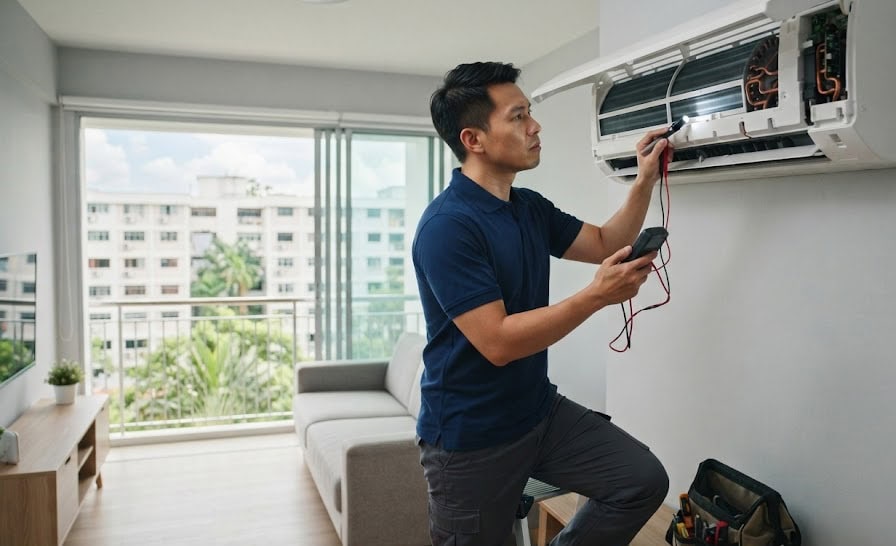
Assessing the physical and mechanical state of inherited multi-split air conditioners inside a resale HDB apartment.
Resale HDB Aircon Takeover Guide (2026): Keep, Overhaul, or Replace?
Collecting the keys to your resale HDB flat is a massive milestone. You have survived the grueling search, signed the paperwork, and paid the option fee. But the moment you open the door of your newly acquired home, reality hits. As you walk through the rooms, you look up and see a set of yellowed, dusty indoor air conditioning units. The previous owner claims they “still work perfectly,” but you have no idea when they were last serviced, how much electricity they gulp down, or if they are harboring a decade’s worth of mold and dust mites.
In Singapore’s oppressive tropical heat, where daytime temperatures regularly cross 32 degrees Celsius, air conditioning is not a luxury. It is a fundamental necessity for survival. When taking over a resale flat, making the wrong decision about your aircon can cost you thousands of dollars down the road. If you rush to replace everything, you might throw away a perfectly functional system that simply needed a deep clean. Conversely, if you decide to keep an ancient, decaying system, you risk ruining your expensive new carpentry and false ceilings when the old pipes inevitably leak and sweat.
This guide provides a professional engineering perspective to help you evaluate your inherited multi-split aircon system. We will walk through diagnostic checks, look at the physical limitations of your equipment, and help you decide whether to keep the system, book a professional chemical overhaul, or invest in a brand-new installation.
The 5-Point Inherited Aircon Audit (DIY & Professional Diagnostics)
Before you make any plans with your interior designer, you must perform a thorough audit of the existing air conditioning setup. Do not simply turn on the units, feel a slight breeze, and assume everything is fine. An old system can run cold for twenty minutes before freezing up, spitting water, or tripping your DB box. Perform this systematic five-point physical inspection to understand exactly what you are dealing with.
1. Fancoil Unit (FCU) Internal Assessment
Grab a ladder and a strong flashlight. Pop open the front plastic cover of each indoor fancoil unit and slide out the mesh dust filters. Look directly at the aluminum evaporator coils. Are they shiny silver, or are they covered in a thick, grey blanket of dust and hair? Next, shine your light down into the horizontal slot where the cold air blows out. Look closely at the cylindrical blower wheel. If you spot black spots or fuzzy, velvet-like growths, you are looking at toxic mold spores. When the fan runs, these spores are blown directly into your living spaces, triggering asthma, allergies, and respiratory issues.
2. Refrigerant and Compressor Diagnostics
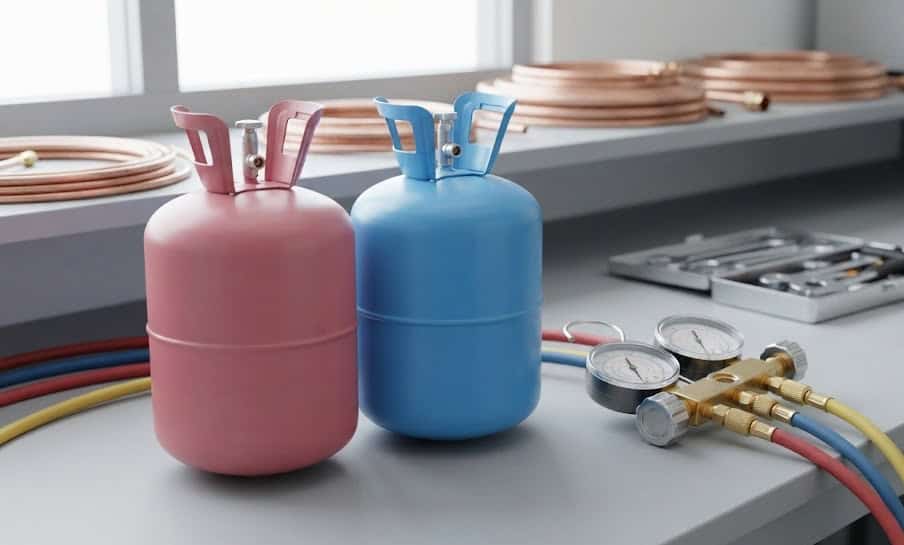
Walk out to the aircon ledge or service yard to inspect the outdoor condenser unit. Look at the silver metal manufacturer plate on the side of the casing. Locate the “Refrigerant Type” field. This is a critical piece of information. If it says R22, you are dealing with an obsolete gas that is phased out in Singapore due to environmental regulations. Finding replacement parts or topping up R22 gas is incredibly expensive. If it says R410A, the system is from the previous decade—workable, but less efficient. If it says R32, you have struck gold; this is the current energy-efficient standard. While you are there, switch on all indoor units to their lowest temperature and maximum fan speed. Listen to the compressor. A healthy compressor should hum smoothly. If it makes a loud, metallic clanking, rattling, or deep grinding noise, the internal bearings or the compressor motor are near the end of their lifespan.
3. Copper Piping and Insulation Thickness
Modern air conditioning systems rely on copper pipes wrapped in elastomeric foam insulation to transport cold refrigerant gas between the indoor and outdoor units. In Singapore, many cheap contractors historically used 3/8-inch standard insulation (often Class 1 rated). Over time, this thin insulation degrades, loses its thermal properties, and starts to “sweat.” When condensation forms on the outside of the pipes, it slowly drips onto your drywall, plaster ceiling, or customized built-in wardrobes, causing rot and unsightly brown water stains. Feel the insulated pipes where they exit the wall. If they feel soggy or if you see visible dripping, the insulation has failed. You should also check the copper pipe gauge. Modern R32 systems operate at much higher pressures than old R22 systems, requiring thicker G22 (0.71mm) copper pipes to prevent catastrophic gas leaks.
4. Drainage Line Assessment
Every fancoil unit extracts moisture from the humid air, which drips into an internal drain pan and flows away through a plastic drain pipe. Find where this pipe runs. In most HDB flats, it runs along the wall and discharges into a floor trap in the nearest toilet or service yard. Check the gradient of the pipe. If it sags or runs uphill, water will back up and overflow from your fancoil. Shake the pipe gently; if you hear a squelching sound, the pipe is choked with a thick, gelatinous jelly. This jelly is a mix of dust, skin cells, and bacteria that breeds in stagnant water. It is the number one cause of water leaking from aircon units in Singapore.
5. Electrical Cabling and Connection Points
The electrical wiring connecting your compressor to the indoor units must be safe and compliant. Look at the isolating switch near the outdoor condenser. Check for any exposed copper, burnt plastic housings, or amateur electrical tape joints. In older resale flats, previous owners may have illegally spliced wires or bypassed safety fuses to keep a failing system running. Any sign of burnt smells or flickering power lights on your indoor units during operation indicates a serious electrical hazard that requires immediate attention.
| System Age | Gas Type | Physical Condition | Electrical/Piping Status | Recommended Action Pathway |
|---|---|---|---|---|
| 1 to 3 Years | R32 (Modern) | Light dust, coils clean, quiet condenser | Cables intact, no piping condensation | Standard chemical servicing & filter wash |
| 4 to 7 Years | R410A / R32 | Heavy dust, mold on blower, mild odour | Slightly worn insulation, clear drainage | Full Chemical Overhaul of fancoils |
| 8+ Years | R410A (Inverter) | Severe mold, black jelly in pan, rusted fins | Condensation on walls, slow cooling | Chemical Overhaul vs. Replace (Check Compressor) |
| 10+ Years | R22 (Obsolete) | Corroded coils, weak airflow, loud compressor | Degraded piping, frequent leaks, high bills | Complete Replacement of system and piping |
The Cost of Neglect: Airflow & Power Draw Impact
Homeowners often underestimate how quickly a neglected air conditioning system degrades. When dust and mold accumulate on the fine aluminum fins of the evaporator coil, they block the airflow. To compensate for the restricted airflow, you end up turning down the temperature setting on your remote control and boosting the fan speed. This forces the compressor to work twice as hard, running at maximum speed for extended periods without cycling down.
The chart below shows the typical correlation between airflow loss (measured in Cubic Feet per Minute, or CFM) and the resulting spike in electrical power consumption over a decade of operating an aircon without deep chemical intervention. Within just five years of operation in a typical dusty HDB environment, airflow can drop by up to 35%, while monthly electricity bills spike by over 25% due to thermal transfer inefficiency.
Deciding Factor 1: The Chemical Overhaul Route
If your inherited aircon system is between 3 to 7 years old, running on R410A or R32 refrigerant, and has no structural leaks or major mechanical faults, you do not need to spend thousands of dollars on a complete replacement. A standard clean is insufficient for a system with years of neglected build-up, but a professional chemical overhaul will effectively restore it to factory-fresh performance.
Do not confuse a chemical overhaul with a basic chemical wash or spray. A basic wash involves spraying a foaming chemical directly onto the front of the coils while they are still mounted on your wall. This is a superficial fix. It pushes the dissolved dirt and corrosive chemicals deeper into the hard-to-reach core of the fancoil unit, where they slowly eat away at the copper tubes, causing pinhole leaks within months.
A genuine, professional chemical overhaul is a comprehensive mechanical restoration process:
- Complete Dismantling: The technician completely disconnects the fancoil from the wall brackets, safely pumps down the refrigerant gas into the condenser unit, and carries the entire fancoil to your bathroom or yard area.
- Chemical Bath: The copper coil and aluminum fins are completely submerged in a specialized alkaline chemical bath. This solution breaks down the stubborn, compacted grease, dust, pet dander, and biological slime without corroding the metal surfaces.
- Blower Wheel Restoration: The cylindrical blower wheel is extracted and pressure-washed to remove the thick crust of mold and dust that causes the fan to wobble, vibrate, and run loudly.
- Drain Pan & Line Flushing: The plastic drain pan is thoroughly scrubbed with anti-fungal disinfectants, and high-pressure water vacuum pumps flush the drain lines clear of any biological jelly blockages.
- Bearing Lubrication: The fan motor bearings are lubricated with high-grade synthetic grease to reduce friction and eliminate annoying squeaking noises.
Opting for a chemical overhaul is highly effective if the system is structurally sound but clogged. It saves you the high cost of buying new units and avoids the disruption of hacking walls or installing new copper pipes through your freshly painted rooms. To see detailed transparent pricing and explore chemical restoration services, you can review the current package rates on the aircon chemical overhaul and servicing diagnostic page.
However, if the system is extremely old, running on R22 gas, or has major compressor damage, spending money on a chemical overhaul is a temporary plaster on a deep wound. In the next section, we will analyze the technical and financial conditions that make a complete system replacement the only sensible option for your resale HDB flat.
Deciding Factor 2: The Full Replacement Route
There comes a point where keeping a legacy aircon system operational stops being financially sensible. While a chemical overhaul can work miracles on dirty but functional fancoils, it cannot reverse structural metal fatigue, compressor motor wear, or thermodynamic obsolescence [ACS-2026-ENG]. If your inherited system is nearing its tenth year, running on old R22 gas, or showing signs of widespread copper corrosion, planning a full replacement is the most rational path forward.
One of the most complex decisions you will face during a resale HDB renovation is whether to replace the existing copper piping. Many homeowners try to save money by opting for a “compressor and fancoil change only” while reusing the old pipes hidden behind their walls. In most cases, this is a costly mistake. If your previous system was running on R410A refrigerant and you are installing a modern, energy-efficient R32 system, the oil inside the pipes presents a massive compatibility challenge.
R410A systems use synthetic polyolester (POE) oil, which is highly hygroscopic—meaning it absorbs moisture from the air instantly. If old pipes are exposed to the atmosphere during renovation, this residual oil becomes highly acidic. When you connect a new R32 compressor to these old pipes, the acidic residue mixes with the new R32 synthetic oil. This contamination strips the protective lacquer coating off the copper motor windings inside your new compressor, leading to an electrical short-circuit and total compressor failure. Most major manufacturers will immediately void your multi-year warranty if their technicians discover that the new unit was connected to legacy copper pipes without professional treatment.
What’s more, R32 refrigerant operates at working pressures that are roughly 1.6 times higher than older systems. To handle this high pressure without leaking, your copper pipes must have a thick structural wall. Older installations often utilized G23 grade copper piping, which has a thin wall of only 0.61mm. Modern high-pressure R32 gas can cause these thin-walled pipes to burst at the joint connections over time. For safe, long-term operation, you must insist on G22 grade copper piping, which boasts a minimum wall thickness of 0.71mm. This thickness provides the mechanical strength needed to withstand pressure fluctuations during rapid cooling cycles.
The insulation wrapping the copper pipes is just as vital as the metal itself. In Singapore’s humid air, cold copper pipes will sweat profusely if they are not insulated correctly. Many older resale flats were fitted with basic Class 1 insulation with a wall thickness of only 3/8-inch. For a modern R32 installation, you should upgrade to high-density, closed-cell Class 0 elastomeric foam insulation—such as Class 0 Armaflex—with a minimum thickness of 1/2-inch. Class 0 insulation has a high resistance to moisture vapor transmission and is certified fire-retardant. This thick barrier prevents the outer surface of the insulation from reaching the dew point, keeping your new false ceilings completely dry and free from mold.
To help you navigate this complex financial decision, we have developed a dynamic calculator to evaluate whether repairing your current system or investing in a new installation makes the most financial sense for your specific situation. This tool runs entirely on local, error-isolated code, making it instantly compatible with page speed optimizers like Flying Scripts and WP Rocket.
Resale HDB Repair vs. Replace Cost Calculator
Input your current inherited system’s details to calculate the most cost-effective path over a 5-year outlook.
Our Recommended Action:
Chemical Overhaul Recommended
A thorough professional chemical overhaul will clear out dust and organic buildup, restoring the system’s cooling efficiency and prolonging its life without the need for a costly replacement.
5-Year Total Cost of Ownership (TCO) Comparison
When evaluating the financial side of the decision, looking only at the initial cost of installation can be misleading. To illustrate this, let us compare the five-year cumulative cost of two common scenarios: keeping an inherited, eight-year-old three-tick R410A system running via patchy repairs and regular servicing, versus replacing it immediately with a modern five-tick R32 system.
The table below breaks down the realistic costs of both approaches, highlighting how a higher upfront investment can lead to significant savings over time.
| Cost Component (5-Year Outlook) | Scenario A: Retain & Repair Old System (3-Tick R410A) | Scenario B: Upfront R32 Replacement (5-Tick Inverter) |
|---|---|---|
| Initial Capital Outlay (Installation) | $0 | $3,400 (Avg. System 3 Standard Setup) |
| Annual Standard Servicing Costs | $750 ($150/year) | $500 ($100/year under initial maintenance contract) |
| Expected Out-of-Warranty Repairs | $1,750 (Capacitors, fan motors, gas leaks) | $0 (Fully covered under comprehensive warranty) |
| Cumulative Electricity Costs | $7,000 (Avg. $1,400/year based on aging compressor) | $4,250 (Avg. $850/year with high-efficiency 5-Tick) |
| Total 5-Year Financial Commitment | $9,500 | $8,150 |
As the calculations demonstrate, keeping the old system alive with patchy repairs actually ends up costing you more. In addition to the extra $1,350 spent, you also have to deal with the ongoing frustration of water leaks dripping onto your wooden floors, warm air blowing on hot nights, and the hassle of coordinating emergency repair appointments on your weekends.
NEA Standards and HDB Structural Regulations (2026)
Replacing an air conditioning system in a Singapore flat is not just a personal aesthetic choice. It is a strictly regulated engineering process overseen by the National Environment Agency (NEA), the Housing & Development Board (HDB), and the Building and Construction Authority (BCA).
To reduce household carbon emissions, NEA has implemented strict energy performance standards. Under these current regulations, older low-efficiency systems are being phased out in favor of eco-friendly R32 refrigerant. If you install a new multi-split system, choosing high-efficiency models with more energy-saving ticks ensures your household electricity bills remain manageable, despite rising utility tariffs. Additionally, systems running on R32 gas are safer to maintain, highly effective at heat transfer, and have a much lower global warming potential than previous generations.
When it comes to structural installation, HDB's rules are very clear. Your outdoor compressor must only be mounted on approved structural aircon ledges or held securely by safety-certified stainless steel brackets. The bracket must be made of Grade 304 or Grade 316 structural-grade stainless steel to resist rust and environmental wear. It must be anchored into the concrete wall of your block using heavy-duty, mechanical expansion stainless steel bolts.
By law, any technician carrying out an aircon bracket installation on an external HDB wall must hold a valid BCA installer certificate. This training ensures they understand weight-loading calculations and correct anchoring depths, preventing any risk of structural collapse. They must also follow strict Ministry of Manpower (MOM) safety guidelines. This includes wearing proper personal protective equipment (PPE) and using certified fall-arrest safety harnesses when working at height on your service yard ledge.
Professional Verification & Engineering Assurance: Evaluating these complex regulatory and mechanical requirements is much easier with professional support. Operating as an NEA-Licensed cleaning and technical service contractor since 2011, our expert team has built trusted relationships with over 43,000 Facebook followers and maintains a solid 4.8-star Google review rating. We carry out structural checks, pressure testing, and chemical restorations with complete transparency, ensuring your home remains cool and fully compliant with all local housing guidelines.
Frequently Asked Questions about Resale HDB Aircon Takeovers
Can I reuse my old copper pipes when getting a new aircon in my resale HDB?
Reusing old copper pipes is generally not recommended, especially when transitioning from an older R410A system to a modern R32 system. R32 operates at much higher pressures, requiring thicker G22 grade copper (0.71mm thickness) to prevent gas leaks. Additionally, residual oil from the old compressor can contaminate the new system and void its manufacturer warranty. Reusing old pipes is only viable if the pipes are verified as high-pressure compliant and have been professionally flushed with nitrogen to remove all old oil and moisture.
Should I perform a chemical overhaul before or after my flat's renovation?
If you plan to keep your inherited system, you should schedule a chemical overhaul after the dusty phase of your renovation is complete but before you move in. Renovation works—such as hacking walls, installing drywall, and sanding carpentry—create massive amounts of fine gypsum and sawdust. If your aircon is run during this time, it will suck up this dust, immediately clogging your freshly cleaned coils and blower wheels. Keep the units completely covered with protective plastic sheeting during renovation, and perform the chemical overhaul as a final cleaning step before moving in.
How do I know if my resale HDB's aircon is running on obsolete R22 refrigerant?
You can check the chemical specification plate on the side of your outdoor compressor unit. It will clearly display the refrigerant type as R22, R410A, or R32. If the plate is unreadable or missing, you can look up the model number of your indoor fancoils online or have a technician check the operating pressures. R22 is an obsolete gas, meaning replacement parts are difficult to find and gas top-ups are very expensive. If your inherited system runs on R22, planning a complete replacement is highly recommended.
Is a chemical overhaul safe for older fancoils, or will it cause copper corrosion?
A professional chemical overhaul is entirely safe when performed by experienced technicians who use correctly diluted, non-acidic alkaline cleaning solutions. Acidic washes can corrode the aluminum fins and copper tubes if left on too long, leading to micro-leaks. Our process uses safe alkaline solutions, followed by thorough high-pressure water neutralisation to ensure all chemical residues are completely flushed away, leaving the metal pristine and intact.
What are the BCA and HDB regulations for replacing an outdoor compressor bracket?
Any outdoor bracket installation on an external HDB wall must be performed by a BCA-certified structural installer. The bracket must be made of rust-resistant stainless steel (typically Grade 304) and secured to the structural concrete using certified heavy-duty expansion anchor bolts. The installer is also required to submit an official installation report to HDB to verify that all structural safety guidelines have been met.
Conclusion & Professional Roadmap
Deciding what to do with your inherited air conditioning system is a critical early step in your resale HDB renovation journey. Making this choice early allows you to coordinate seamlessly with your interior designer and contractor, ensuring they plan their carpentry, false ceilings, and painting schedules around the necessary pipe routing. This avoids the stress of having to hack open newly finished walls to fix a leaking pipe or replace a broken unit after you move in.
If your diagnostics show that your inherited system is relatively modern, a professional chemical overhaul will clear out years of build-up and restore its cooling efficiency. However, if the system is aging, inefficient, or showing signs of structural wear, investing in a modern R32 system is the most cost-effective decision for the long run, saving you from high energy bills and constant breakdown headaches.
Our experienced team is here to help you navigate this process. From initial diagnostic audits and professional chemical overhauls to complete structural installations, we ensure your home stays cool, safe, and fully compliant with all Singapore regulations. To plan your system upgrade and explore energy-efficient options, get in touch with our team today through our aircon replacement and installation services page.