The Definitive Daikin Aircon Error Code Directory (2026): Diagnostic Guide for Singapore Homes
July 16, 2026
2026 HDB Interior Trends: How to Safely Conceal Aircon Piping in False Ceilings
July 18, 2026The Comprehensive Panasonic Aircon Error Code Directory (2026): Diagnostic and Troubleshooting Guide for Singapore Homeowners
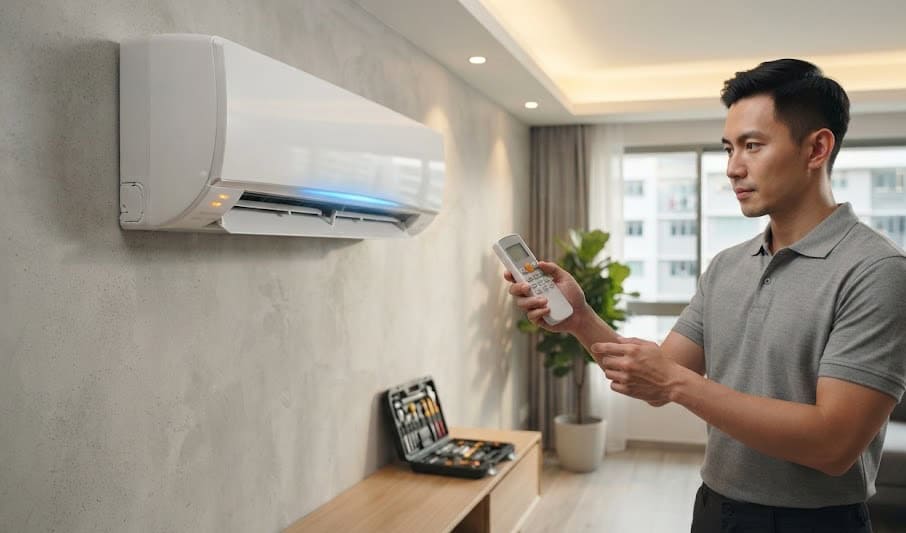
Troubleshooting a flashing timer lamp on a Panasonic home inverter system to extract active H-type or F-type fault codes.
The Comprehensive Panasonic Aircon Error Code Directory (2026): Diagnostic and Troubleshooting Guide for Singapore Homeowners
If your home is equipped with a Panasonic inverter split system—such as the premium XS, YS, or standard inverter series—you likely enjoy the advanced benefits of their nanoe-g air purification and iAuto-X rapid cooling technologies. These systems are highly regarded across Singaporean HDB flats, condos, and landed properties for their quiet operations and steady cooling curves. However, like any advanced piece of engineering, your Panasonic aircon can occasionally encounter operating faults. This usually manifests as the system suddenly shutting down, the louvers closing up, and the orange TIMER LED light on your fancoils blinking steadily.
When the orange timer light begins to flash, it is easy to assume your system is completely broken. Many homeowners worry about facing a massive replacement bill. In reality, Panasonic’s intelligent onboard diagnostic system is simply telling you that one of its internal sensors, communication circuits, or mechanical components is operating outside its safety design parameters. By performing a quick diagnostic query using your remote controller, you can read the exact alphanumeric fault code and find out exactly what is happening inside your system.
This directory serves as your definitive diagnostic resource for Panasonic air conditioners. We will explain how to extract these diagnostic codes step-by-step, provide an exhaustive, unfiltered table of every known fault code, and analyze the physical root causes behind these issues to help you decide whether a simple DIY reset is enough or if professional repair is needed.
How to Extract Panasonic Error Codes Using Your Remote
Unlike other brands that display error codes directly on the fancoil screen, Panasonic indoor units communicate faults via a blinking orange “TIMER” LED light. To read the exact alphanumeric error code (such as H11 or F91), you must use your wireless remote controller to query the fancoil’s internal circuit board.
Follow this simple step-by-step sequence to retrieve the active fault code:
- Locate the Check Button: Find a small, recessed button labeled “CHECK” on your remote control panel. You will need a paperclip or a pen tip to press it.
- Activate Query Mode: Press and hold the “CHECK” button for roughly 5 seconds. The remote controller screen will clear, displaying two dashes (“–“) along with a check icon.
- Cycle Through Codes: Point the remote at the blinking fancoil and press the “TIMER” up or down arrow buttons. The remote will cycle through the entire directory of alphanumeric codes (H11, H14, H15, etc.), sending a signal to the fancoil for each code.
- Listen for the Beep: For every incorrect code, the fancoil will emit a standard, single short beep. However, when you reach the active fault code that is currently causing your system to blink, the fancoil will emit a continuous, long beep. The code displayed on your remote screen at that exact moment is your active error code.
Once you have identified your code, you can refer to the master directory below to understand the exact fault and find the recommended action guide.
Part 1: Exhaustive Panasonic Aircon Error Code Directory
The table below provides a comprehensive list of all known error codes, sensor faults, and mechanical lock protections for Panasonic residential and commercial inverter air conditioning systems.
| Error Code | Fault Description | Summary Fix & Troubleshooting Action |
|---|---|---|
| H11 | Indoor/Outdoor Transmission Abnormality (Signal Loss) | Communication is broken between the fancoil and compressor. Requires professional control wiring and terminal block check. |
| H14 | Indoor Intake Air Temperature Sensor Abnormality | The room temperature sensor is open or short-circuited. Requires professional thermistor replacement. |
| H15 | Compressor Discharge Temperature Sensor Abnormality | The outdoor compressor discharge thermistor is reading faulty resistance. Requires professional replacement. |
| H16 | Outdoor Current Transformer (CT) Abnormality | System detects abnormal input current, often due to an outdoor PCB fault or low gas. Requires professional diagnostic check. |
| H19 | Indoor Blower Fan Motor Mechanism Lock | The indoor cross-flow fan blower motor is seized, dirty, or damaged. Requires professional motor or blower check. |
| H23 | Indoor Heat Exchanger Temperature Sensor 1 Abnormality | The liquid pipe temperature sensor has failed. Requires professional thermistor replacement. |
| H24 | Indoor Heat Exchanger Temperature Sensor 2 Abnormality | The gas pipe temperature sensor has failed. Requires professional thermistor replacement. |
| H25 | Air Purifying System (e-ion / nanoe-g) Abnormality | The ionizer unit has failed or dirty pins are shorting. Clean your mesh first; if code stays, requires professional replacement. |
| H27 | Outdoor Air Temperature Sensor Abnormality | The outdoor ambient air thermistor is broken or disconnected. Requires professional replacement. |
| H28 | Outdoor Heat Exchanger Temperature Sensor Abnormality | The outdoor condenser pipe temperature sensor is faulty. Requires professional replacement. |
| H30 | Outdoor Discharge Pipe Temperature Sensor Abnormality | The compressor discharge temperature sensor has failed. Requires professional replacement. |
| H33 | Indoor/Outdoor Connection Voltage Mismatch | Wiring error or incorrect voltage phase matching between units. Requires professional installation correction. |
| H34 | Outdoor Heat Sink Temperature Sensor Abnormality | The thermistor on the inverter heat sink is reading faulty values. Requires professional PCB servicing. |
| H36 | Outdoor Gas Pipe Temperature Sensor Abnormality | The outdoor gas line temperature sensor is reading incorrect resistance. Requires professional replacement. |
| H37 | Outdoor Liquid Pipe Temperature Sensor Abnormality | The outdoor liquid line temperature sensor is reading incorrect resistance. Requires professional replacement. |
| H38 | Indoor/Outdoor Brand/Model Mismatch | Indoor fancoil and outdoor compressor are incompatible models. Requires professional system check. |
| H50 | Ventilation Fan Motor Abnormality | The indoor exhaust or ventilation motor is locked or faulty. Requires professional motor replacement. |
| H51 | Clean Filter Auto-Mechanism Lock | The auto-cleaning filter brush or motor is physically jammed. Clear any dust or physical blockages. |
| H52 | Left-Right Auto Vane Limit Switch Abnormality | The motorized horizontal flap motor has failed. Requires professional motor replacement. |
| H58 | Air Purity Gas Sensor Abnormality | The indoor air quality sensor is faulty or disconnected. Requires professional replacement. |
| H97 | Outdoor Fan Motor Mechanism Lock | The outdoor condenser fan blade is seized, blocked, or the motor has failed. Requires professional motor replacement. |
| H98 | Indoor High-Pressure Protection (Overheating) | The indoor coil is running too hot, often due to dirty filters or low gas. Clean filters first; if code stays, requires professional check. |
| H99 | Indoor Operating Coil Freeze Prevention | The indoor coil is freezing due to restricted airflow or low gas. Clean filters; if code remains, requires professional diagnostics. |
| F11 | 4-Way Valve Reversal Abnormality | The reversing valve is stuck, preventing the system from switching cycles. Requires professional valve replacement. |
| F17 | Indoor Standby Units Freezing Abnormality | In a multi-split setup, an idle unit is freezing due to expansion valve leakage. Requires professional valve replacement. |
| F90 | Power Factor Correction (PFC) Circuit Abnormality | High-voltage DC link has experienced a voltage surge or short-circuit. Requires professional inverter PCB replacement. |
| F91 | Refrigeration Cycle Abnormality (Low Gas/Leak) | The system has detected a gas shortage or cycle blockage. Requires professional pressure check and R32 top up. |
| F93 | Compressor Abnormal Rotation (Sync Loss) | The compressor compressor has lost synchronization or has a locked rotor. Requires professional compressor diagnostics. |
| F95 | Outdoor High-Pressure Protection (Overheating) | The outdoor condenser has overheated or is overcharged with gas. Clean the condenser coil first; if it stays, requires professional check. |
| F96 | IPDU (Intelligent Power Drive Unit) Overheating | The power transistor module is overheating, often due to dried heat sink paste. Requires professional PCB servicing. |
| F97 | Compressor Overheating Protection | The compressor thermal cut-out is active due to extreme thermal load or gas shortage. Requires professional leak check. |
| F98 | Total Running Current Protection (Overcurrent) | The total system current draw has exceeded safe limits. Requires professional electrical diagnostics. |
| F99 | Outdoor Direct Current (DC) Peak Current Detection | The power transistor module has experienced an overcurrent spike or short-circuit. Requires professional PCB replacement. |
Distribution of Common Panasonic Fault Triggers in Singapore
In Singapore’s tropical environment, certain Panasonic aircon faults occur much more frequently than others. The high relative humidity (regularly crossing 80%) combined with high operating loads creates specific thermal stresses and connection wear that are not as common in cooler climates.
The chart below details the statistical frequency of core Panasonic fault triggers based on our historical field service data for residential Panasonic split systems across Singapore estates.
As the diagnostic chart shows, sixty-five percent of all Panasonic aircon faults in Singapore are caused by indoor-to-outdoor signal loss (H11) and coil freezing (H99/H98). These two issues are highly linked to Singapore’s humid climate, which accelerates connection corrosion and coil icing when filters are dirty.
If you are experiencing any of these common errors, understanding the physical cause behind the code can help you take fast, correct action. To schedule an on-site diagnostic check or professional repair, you can review our diagnostic packages on our aircon troubleshooting and servicing page.
In the next section, we will analyze the technical root causes of these common faults in detail, explain what safe DIY checks you can perform to reset your system, and clarify when professional parts replacement is mandatory.
Deep-Dive Thermodynamic & Mechanical Analysis of Critical Codes
Deciphering an alphanumeric code displayed on your remote screen is only the first step. To permanently resolve a recurring issue, you must understand the underlying physical and mechanical failures that trigger these specific codes. In Singapore’s tropical climate, certain environmental factors accelerate specific system failures.
H11 Error: Indoor/Outdoor Serial Transmission Abnormality
The H11 code is the most common and frustrating error code encountered by Panasonic owners in Singapore. It indicates a total breakdown in data communication between the indoor fancoil units and the outdoor compressor. To coordinate variable cooling cycles, the indoor and outdoor control boards must continuously exchange serial data signals along a three-core interconnecting cable, commonly wired into S1, S2, and S3 terminals.
The S1 terminal carries 230V AC active line voltage, S2 acts as the neutral line, and S3 carries the pulsing digital signal. This digital data loop relies on a pulsing DC signal that rides on the S2 neutral line. When you measure the voltage between S2 and S3 using a digital multimeter set to DC voltage, you should see a constantly fluctuating reading between 0V and 24V DC.
In Singapore, many condos and HDB estates have outdoor compressor ledges exposed to heavy rains and saltwater-laden coastal air. This moisture penetrates the terminal block of the outdoor unit, causing copper-oxide corrosion on the screw terminals. This corrosion increases electrical resistance, distorting or completely blocking the digital communication signal between the units. If the indoor fancoil’s microcontroller fails to receive handshake packets within a specific timeout window, it immediately cuts off compressor operation and displays the H11 code to prevent damage.
F91 Error: Refrigeration Cycle Abnormality
The F91 code is the primary indicator of a low refrigerant gas charge or a physical cycle blockage inside your Panasonic system. Panasonic systems detect low gas by continuously monitoring the indoor liquid pipe thermistor (H23) and the gas pipe thermistor (H24). Under standard operating conditions, the temperature difference between these two sensors (Delta-T) should remain within a specific range of 5 to 8 degrees Celsius as heat exchange occurs uniformly.
If your system develops a slow pinhole leak at the copper flare joints, the refrigerant mass flow rate drops. This cause the liquid pipe sensor to freeze up rapidly while the gas pipe remains warm. The temperature difference shifts abnormally, and the compressor starts running hotter (F97) while drawing less electrical current (H16) due to the reduced gas load. Once the system’s algorithm registers this abnormal cycle over several consecutive minutes of active operation, it shuts down the system and displays F91. Locating these micro-leaks in multi-split System 3 or 4 setups is labor-intensive, requiring high-pressure nitrogen testing to find the exact source of the leak before carrying out an R32 top up.
H99 Error: Indoor Operating Coil Freeze Prevention
The H99 code is a critical safety protection feature designed to prevent your indoor evaporator coil from turning into a solid block of ice. Under standard operation, the blower fan pulls warm, humid room air across the freezing aluminum fins of the evaporator coil, transferring heat and cooling the room.
However, if your mesh dust filters are heavily clogged or your indoor blower fan motor is locked (H19), this heat exchange stops. The temperature of the copper tubes drops below 0 degrees Celsius, causing the condensate water on the fins to freeze into ice. The H23 liquid pipe sensor detects this sub-zero temperature and triggers the H99 code to shut down the compressor before the fancoil turns into a solid block of ice, which would otherwise crack the plastic casing and cause severe water leakage.
5-Year Financial & Performance Risk Profile of Common Codes
When your system displays an error code, choosing to ignore it and continuing to force the system to run can lead to serious mechanical damage. Many minor sensor faults can be resolved cheaply, but ignoring them forces the compressor to run under abnormal thermal conditions, leading to premature motor failure.
The table below compares the long-term operational and financial consequences of addressing critical Panasonic codes early versus ignoring them.
| Active Fault Code | Monthly Power Impact | Immediate Repair Cost (SGD) | 5-Year Structural Risk | Recommended Action Pathway |
|---|---|---|---|---|
| H11 (Signal Loss) | Zero (System locked out) | $120 – $220 (Terminal block / wire swap) | Minimal (Electrical safety lock active) | Check terminal blocks for corrosion; replace S2/S3 control wiring |
| F91 (Gas Leak) | Spikes up to 30% (Compressor ramps continuously) | $250 – $450 (Pressure test + R32 recharge) | High (Compressor motor winding burnout) | Perform nitrogen leak test, seal flare joints, vacuum and recharge |
| H99 (Coil Freezing) | Spikes up to 20% (Thermal transfer blocked) | $80 – $180 (Filter wash / blower service) | Moderate (Fancoil casing cracks, water damage) | Clean filters immediately; check for blower motor locks or low gas |
As the risk table clearly shows, addressing fault codes early protects your wallet from expensive future repairs. Continually resetting a system to bypass safety codes like H99 or F91 forces your compressor to run under extreme thermal stress, leading to motor burnout and requiring a complete system replacement.
Homeowner Safe DIY Troubleshooting Checklist
When your aircon displays an error code, you do not always need to pay for a technician immediately. Homeowners can safely carry out a few basic, non-invasive diagnostic checks to see if the issue is a simple glitch that can be resolved with a quick reset.
1. The Hardware Reset (Isolator Switch Cycle)
Modern inverter air conditioning systems are essentially complex, wall-mounted computers. Like any computer, the internal microprocessors can occasionally experience software lockups, memory buffers running full, or minor power spikes that cause the communication chip to crash, throwing a false H11 error.
To perform a hardware reset, locate your aircon’s master rotary isolator switch (usually found on your service yard wall, external aircon ledge, or balcony) and turn it to the “OFF” position. Alternatively, flip the dedicated aircon circuit breaker inside your home’s DB box to “OFF”. Leave the system completely powered down for at least 15 minutes. This allows the high-capacity capacitors on the outdoor inverter board to drain their stored charge completely, resetting the board’s volatile memory. Flip the switch back to “ON” and start the unit. If the code was caused by a temporary electrical glitch, the system will restart and run normally.
2. Static Pressure Filter Wash
If your system is displaying an H99 (freeze protection) code, the issue is often caused by a severe restriction in airflow across your indoor evaporator coils. When your mesh dust filters are heavily clogged, the fancoil’s blower fan cannot pull enough warm room air across the freezing coils.
Without sufficient warm air to heat the coils, the temperature of the refrigerant drops below freezing, causing the condensate water on the fins to turn into solid ice. The system detects this abnormal temperature drop and cuts power to prevent compressor damage. Slide out your indoor filters, wash them under a tap to remove all dust, let them dry completely, and reinstall them. This simple step restores proper airflow and often resolves the H99 error permanently.
3. Clearing Outdoor Condenser Obstructions
If your system is throwing an F95 or F97 (high-pressure/overheating) code, walk out to your aircon ledge or balcony and inspect the outdoor condenser. In Singapore, many homeowners use their service yards or balcony ledges to store laundry racks, plastic boxes, or cleaning supplies.
If you stack items directly in front of the outdoor unit, you block the discharge fan. The hot air cannot blow away, causing heat to build up inside the condenser cabinet. This spikes the operating pressure, triggering high-pressure safety protection. Clear all items away from the condenser, ensuring at least 300mm of clear space around the sides and 1000mm in front, to allow the heat to dissipate freely.
Professional Verification & Engineering Assurance: Evaluating these complex regulatory and mechanical requirements is much easier with professional support. Operating as an NEA-Licensed cleaning and technical service contractor since 2011, our expert team has built trusted relationships with over 43,000 Facebook followers and maintains a solid 4.8-star Google review rating. We carry out structural checks, pressure testing, and chemical restorations with complete transparency, ensuring your home remains cool and fully compliant with all local housing guidelines.
Frequently Asked Questions about Panasonic Aircon Error Codes
Why is my Panasonic timer light blinking, but no code is shown on the remote?
A blinking orange “TIMER” light on a Panasonic fancoil indicates an active fault has been detected, but the wireless remote does not display these codes automatically. You must manually activate the query mode by holding down the “CHECK” button on your remote with a paperclip for 5 seconds until the screen displays two dashes (“–“), then cycle through the codes using the timer arrow buttons. When the fancoil emits a continuous, long beep, the active code will be displayed on your remote screen.
How much does it cost to replace a Panasonic indoor fan motor in Singapore in 2026?
The cost of replacing an indoor fancoil blower motor (H19) in 2026 typically ranges between $180 and $350, depending on your specific fancoil model capacity. We recommend using original OEM fan motors to ensure quiet operation and compatibility with the fancoil’s control board.
Can I run my Panasonic aircon safely if it is displaying an H99 or F91 code?
No, you should not run your system if these codes are active. An H99 code indicates the coils are freezing, which can lead to ice buildup that cracks the plastic casing and causes severe water damage to your home. An F91 code indicates low refrigerant gas, which means the compressor is running without proper cooling and lubrication, leading to compressor motor burnout. Always turn off the power and resolve the issue first.
Will washing my filters resolve an active H11 communication code?
No, washing your dust filters will not resolve an H11 code. The H11 code is an electrical communication fault between the indoor and outdoor control boards, usually caused by corroded wiring, loose terminal blocks, or a failed PCB. It is completely separate from airflow or filter hygiene issues and requires technical diagnostic inspection.
Does the orange timer light stop blinking automatically after I fix the issue?
Yes, once the underlying mechanical or electrical fault is resolved, the system’s microprocessors will detect that the sensors are reading within safe parameters and will automatically clear the error code, stopping the timer light from blinking. If the light continues to blink after repair, perform an isolator switch reset to clear any cached fault memory.
Conclusion & Renovation Strategy
Deciphering your Panasonic aircon’s error codes is the key to maintaining a comfortable, efficient, and dry home. By reading the blinking timer patterns or pulling alphanumeric codes, you can take fast, correct action before a minor sensor fault escalates into a serious compressor failure.
If your system displays an error code that cannot be resolved with a simple filter wash or isolator reset, working with certified, experienced technicians is highly important. Our professional diagnostic team has the expertise and specialized equipment needed to locate physical leaks, replace damaged PCBs, and restore your system to its original performance. If your old compressor has reached the end of its design life and repairs are no longer cost-effective, we can also help you plan a full system upgrade to a modern, energy-efficient five-tick inverter model. Explore your options and schedule an appointment on our premium Panasonic service page today.