9 VRV Aircon Installation Mistakes To Avoid
August 14, 2019
Aircon Leaking? Learn How To Solve It
August 14, 20198 Critical Tips When Installing Daikin Split Units in SG (2026 Guide)
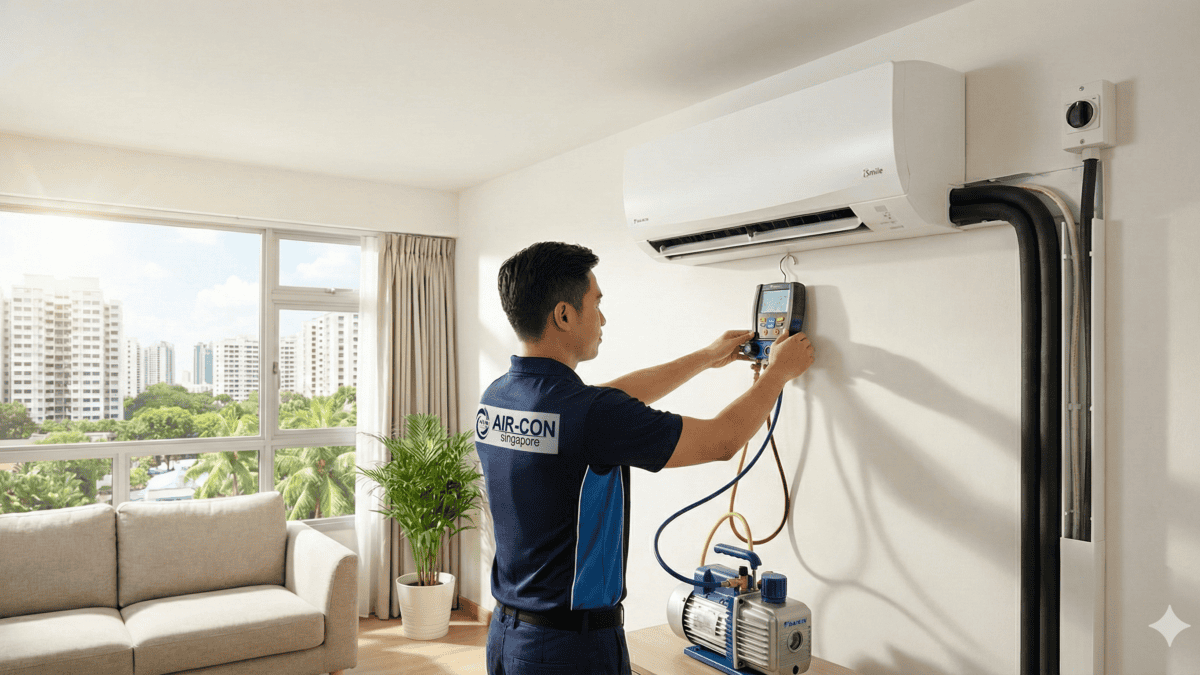
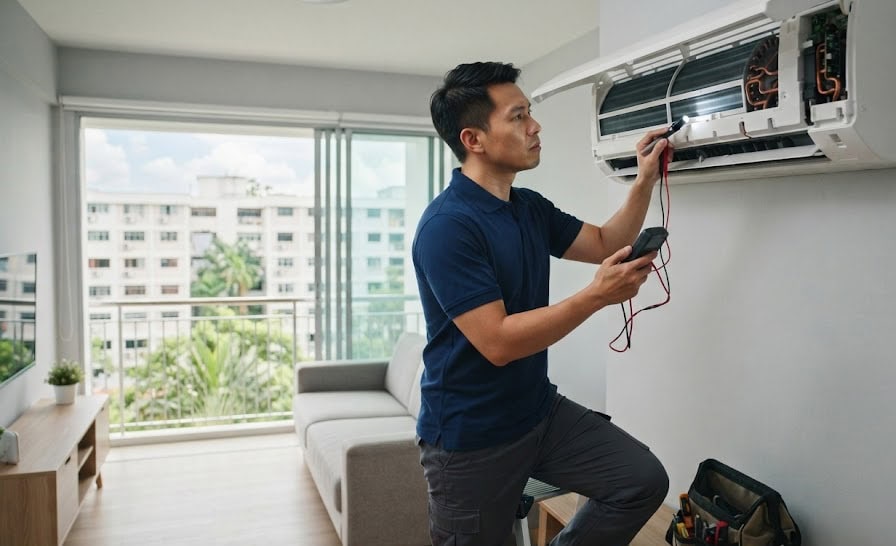
Professional air conditioning technician performing maintenance on a wall-mounted unit in a bright, spacious living room.
By Elvin Yeo, Founder of @bsolute Group
Daikin split-unit air conditioners (like the popular Daikin iSmileEco series) are a top choice in Singapore. They are reliable and save energy. However, living in Singapore’s hot and humid climate means the installation must be perfect. If the installation is poor, even the best aircon will leak or fail to cool.
I have seen many “bad installations” over the last 15 years. To help you avoid these mistakes, here are 8 expert tips for Daikin split unit installation in Singapore.
1. Choose the Right BTU for Singapore Rooms
Many overseas guides suggest low BTU (power) for large rooms. In Singapore, the weather is hot. You need more power. If the BTU is too low, the aircon will run non-stop and spoil quickly.
| Room Type (HDB/Condo) | Approx Size | Recommended BTU |
| Common Bedroom | 100 to 150 sq ft | 9,000 BTU |
| Master Bedroom | 150 to 200 sq ft | 12,000 BTU |
| Living Room (Small) | 250 to 350 sq ft | 18,000 BTU |
| Living Room (Large) | 400+ sq ft | 24,000 BTU |
2. Install a Proper Isolator Switch (Safety First)
Never connect the outdoor unit directly to the power supply without a switch. In Singapore, safety regulations require an Isolator Switch near the outdoor compressor.
- Why? It allows a technician to safely cut off power to the outdoor unit during servicing.
- Voltage: Singapore uses 230V, not 115V. Ensure your installer uses Singapore-standard wiring (3-core wire).
3. Use Thicker Insulation to Stop Leaking
“Sweating” pipes are the #1 cause of trunking leaks in Singapore. Because our air is very humid, cold pipes attract water.
- Tip: Insist on Armaflex Class 1 insulation (or equivalent).
- Thickness: Use at least 1/2 inch (12.7mm) thickness for the piping insulation. Standard 3/8 inch might not be enough for our humidity.
4. Ensure Proper Water Drainage (Gradient)
The water drainage pipe must slope downwards. If it is flat, water will flow back and leak from your indoor unit.
- The Test: Ask your installer to pour a bottle of water into the drainage pan after installation. It should flow out smoothly to the toilet or floor trap immediately.
5. Vacuum the Copper Pipes
Before releasing the gas (refrigerant R32), the installer must use a vacuum pump to remove all air and moisture from the copper pipes.
- Why? If air is left inside, it mixes with the gas and damages the compressor. This shortens the life of your new Daikin.
6. Outdoor Unit Ventilation
Daikin compressors are tough, but they need to “breathe.”
- HDB Ledges: Ensure the back of the compressor is not pressed too tight against the wall. There must be space for air to enter.
7. Plan for Maintenance Access
Think about the future. You will need to service the aircon every 3 months.
- Indoor Unit: Do not install it directly above a tall wardrobe or expensive electronics. Technicians need space to open the cover and wash the filters.
- Outdoor Unit: Ensure it is accessible for safety checks.
8. Set Up the Daikin Mobile Controller
Most modern Daikin units (like the iSmile series) come with built-in Wi-Fi. You do not need an external “application kit” for these.
- Tip: Ask your installer to help you pair the Daikin Mobile Controller App to your phone before they leave. This lets you turn on the aircon before you reach home, a lifesaver in Singapore’s heat!
Frequently Asked Questions (FAQ)
Q: Can I use existing old piping for my new Daikin R32 aircon?
A: It depends. R32 gas runs at a higher pressure. If your old pipes are dirty or too thin (0.61mm), it is safer to install new copper pipes (0.71mm or 0.81mm) to prevent bursting.
Q: How high should the aircon be installed?
A: The indoor unit should be about 2.2m to 2.4m from the floor. Do not install it too close to the ceiling; leave at least 10cm gap for air intake.
Q: Why is my new Daikin aircon not cold?
A: If it is new, it might be a gas leak due to poor installation (loose flare nut). Call your installer back immediately to check the pressure.
Expert Note:
Installing an aircon is not just about hanging a machine. It is about airflow, drainage, and safety. At @bsolute Aircon, we follow strict Singapore aircon NEA guidelines to ensure your Daikin aircon lasts for years.