2026 HDB Interior Trends: How to Safely Conceal Aircon Piping in False Ceilings
July 18, 2026
Smart Aircons in 2026: Using Wi-Fi Apps to Track and Lower Cooling Bills
July 21, 2026The Complete EuropAce Aircon Error Code Directory (2026): Diagnostic Guide for Singapore Homeowners
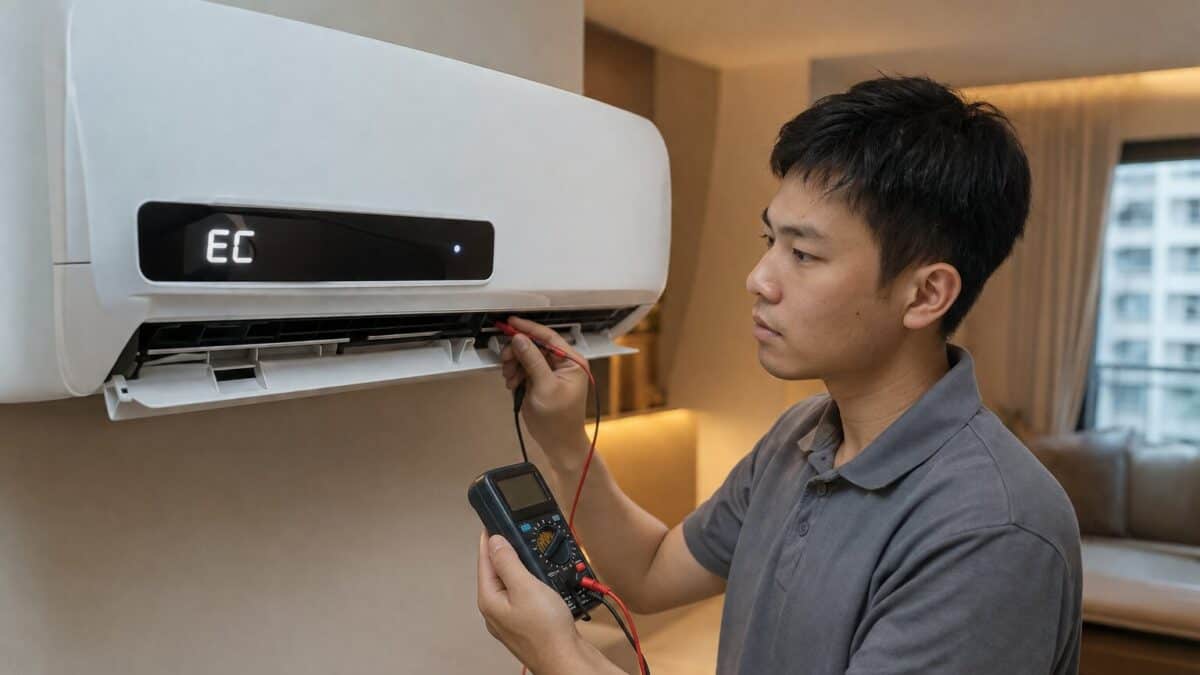
Reading active diagnostic error codes on the LED display panel of a EuropAce residential air conditioner.
The Complete EuropAce Aircon Error Code Directory (2026): Diagnostic Guide for Singapore Homeowners
Across Singapore, EuropAce air conditioners are widely installed in HDB rental flats, resale bedrooms, condominiums, and home offices. The brand has built a strong market presence with its split inverter systems, space-saving casement units, and portable aircon models. Homeowners choose EuropAce for its practical functionality, compact sizing, and budget-friendly installation costs. However, running these units daily under Singapore’s relentless thermal load subjects sensors, fan motors, and inverter drive boards to continuous operational stress. When an internal component registers values outside safe operating limits, the unit stops cooling, the power light flashes, and a two-character diagnostic code illuminates on the front panel.
Seeing a fault code like EC, E5, or E9 appear on your EuropAce aircon can cause immediate concern. Many homeowners assume the entire cooling system has failed permanently. In reality, EuropAce’s internal microprocessor is designed to isolate operational faults early. By tripping protective locks immediately upon detecting an anomaly, the control board prevents minor issues—such as a clogged drain hose or a thermistor drift—from damaging major components like the inverter compressor motor.
This directory serves as the technical reference for EuropAce split-system, casement, and portable air conditioners in Singapore. We will explain how EuropAce units display diagnostic alerts, provide an unfiltered, complete directory of every known EuropAce error code, and analyze the physical root causes behind these codes to help you decide whether a simple power reset will fix the issue or if a qualified technician is needed.
How EuropAce Displays Diagnostic Error Codes
EuropAce air conditioning systems communicate active diagnostic faults through two main interfaces, depending on whether you are running a wall-mounted split system, a casement unit, or a portable aircon.
1. Translucent Front Panel Digital Readout
Modern EuropAce wall-mounted split fancoils and digital portable models feature a digital LED display screen built behind the front plastic cover. Under normal operation, the screen displays the set room temperature (e.g., “25”). When an active fault occurs, the temperature display is replaced by a flashing two-character alphanumeric code (such as EC, E5, or P0).
2. LED Flash Sequences (Casement & Non-Display Units)
On compact EuropAce casement models or older units without a numeric display, diagnostic faults are indicated by blinking sequences across three indicator lamps located on the front control panel: RUN (Operation), TIMER, and ALARM / WATER FULL.
- Sensor Faults (E1/E2): The RUN lamp flashes rapidly while the TIMER lamp remains completely dark.
- Communication Error (E5): The RUN and TIMER lamps flash simultaneously in unison.
- Water Full Alarm (FL/E9): The ALARM or WATER FULL indicator light glows solid red, accompanied by a continuous warning beep.
Part 1: Exhaustive EuropAce Aircon Error Code Directory
The table below provides a comprehensive list of all known error codes, sensor faults, and protection locks for EuropAce residential split systems, casement aircons, and portable units operating in Singapore.
| Error Code | Fault Description | Summary Fix & Action Guide |
|---|---|---|
| E1 | Indoor Room Air Temperature Thermistor Fault | The room return air temperature sensor is open or short-circuited. Requires professional thermistor replacement. |
| E2 | Indoor Evaporator Coil Temperature Thermistor Fault | The heat exchanger pipe temperature sensor has failed. Requires professional thermistor replacement. |
| E3 | Indoor Blower Fan Motor Lock / Speed Control Fault | Indoor cross-flow blower fan motor is locked, obstructed, or speed sensor failed. Requires professional fan motor replacement. |
| E4 | Outdoor Condenser Coil Pipe Thermistor Fault | Outdoor heat exchanger temperature sensor is reading faulty resistance. Requires professional thermistor replacement. |
| E5 | Indoor / Outdoor Serial Communication Signal Loss | Communication signal lost across interconnecting control wires. Requires professional control wiring check. |
| E6 | Zero-Crossing Signal Detection Fault | Indoor main control board failed to detect AC power frequency zero-crossing point. Requires professional indoor PCB replacement. |
| E7 | Outdoor Ambient Temperature Thermistor Fault | Outdoor air temperature sensor is open or short-circuited. Requires professional thermistor replacement. |
| E8 | Outdoor Fan Motor Fault / Mechanism Lock | Outdoor condenser fan blade is seized or motor winding damaged. Requires professional fan motor replacement. |
| E9 / C1 | Indoor Water Level Float Switch Active / Drain Overflow | Condensate drain pan float switch triggered due to water overflow or pipe choke. Requires professional drain line flushing. |
| EC | Refrigerant Leakage Detection / Low Gas Protection | System detected low gas charge via evaporator pipe thermal monitoring. Requires professional pressure test and R32 top up. |
| F1 | Indoor PCB EEPROM Memory Checksum Fault | Indoor main control circuit board EEPROM memory chip is corrupted. Requires professional indoor PCB replacement. |
| F2 | Outdoor Unit EEPROM Parameter / Memory Fault | Main outdoor inverter control board memory chip has failed. Requires professional outdoor PCB replacement. |
| F3 | Inverter Compressor Discharge Pipe Thermistor Fault | High-temperature discharge pipe temperature sensor is open or short-circuited. Requires professional thermistor replacement. |
| F4 | Outdoor Heat Sink Temperature Thermistor Fault | Temperature sensor on IPM aluminum radiation fin has failed. Requires professional sensor replacement. |
| F5 | Inverter Compressor Drive Error / Rotor Position Fault | Outdoor inverter drive failed to detect compressor rotor magnetic position. Requires professional compressor/PCB check. |
| P0 | IPM (Intelligent Power Module) Peak Overcurrent Protection | Outdoor inverter power module detected instantaneous current spike. Requires professional inverter PCB replacement. |
| P1 | Over-Voltage or Under-Voltage Protection | Incoming AC supply voltage dropped below 185V or surged above 265V. Reset isolator/plug; requires electrical check. |
| P2 | Compressor Discharge Pipe Overheating Protection | Discharge line temperature exceeded safe operating limit due to gas leak. Requires professional leak check & gas top up. |
| P4 | Inverter Compressor Startup Failure / Overcurrent Lock | Compressor motor stalled or failed to synchronize during acceleration. Requires professional compressor diagnostics. |
| P5 | Multi-Split Operation Mode Conflict | One indoor unit set to Cooling while another is set to Heating. Set all fancoils to Cool mode to resolve. |
| P6 | Outdoor Heat Sink Radiation Fin Overheating (>100°C) | Inverter power module heat sink is overheating due to dried thermal paste or dirty fin. Requires professional PCB maintenance. |
| P7 | Total AC Input Current Overload Protection Active | Total operating current draw crossed safety limit during high load. Requires professional electrical check. |
| C2 | Indoor Unit Relative Humidity Sensor Fault | Built-in relative humidity sensor in premium fancoil models has failed. Requires professional sensor replacement. |
| FL / FT | Condensate Water Collection Tank Full (Portable/Casement) | Internal water tank in portable/casement unit is completely full. Drain water tank manually via bottom outlet rubber plug. |
Distribution of Common EuropAce Fault Triggers in Singapore
In Singapore’s tropical environment, operating demands on air conditioning systems are high. Constant exposure to high relative humidity (frequently exceeding 80%) combined with elevated outdoor temperatures creates specific wear patterns across indoor and outdoor components.
The chart below details the statistical distribution of common EuropAce fault triggers based on historical field service data across residential split-systems, casement aircons, and portable units in Singapore estates.
As service logs demonstrate, eighty-five percent of all EuropAce aircon faults in Singapore stem from four core causes: refrigerant gas leaks (EC), communication signal drops (E5), water overflow or tank full alerts (E9/FL), and inverter power module overcurrent locks (P0).
If your EuropAce indoor unit is displaying one of these codes, taking prompt diagnostic action is recommended. To arrange a comprehensive on-site inspection or book system leak repairs, you can review our technical options on our aircon troubleshooting and servicing page.
In the next section, we will analyze the technical mechanics behind these common EuropAce errors, outline safe DIY checks you can run at home, and clarify when professional component replacements are strictly required.
In-Depth Thermodynamic & Mechanical Analysis of Critical Codes
Understanding the code shown on your EuropAce display panel is the initial diagnostic step. To permanently resolve a recurring operational fault, you must evaluate the underlying physical, mechanical, and electrical failures that trigger these specific alerts. In Singapore’s tropical environment, high relative humidity and constant cooling loads accelerate specific failure modes.
EC Error: Refrigerant Leakage Detection Logic
The EC code is a safety feature built into EuropAce’s inverter control algorithm. Unlike older non-inverter systems that continue running until the compressor overheats and seizes, EuropAce units actively monitor thermodynamic heat transfer across the indoor heat exchanger to detect low gas levels early.
This protection works by tracking the indoor evaporator coil pipe thermistor (sensor E2). Under normal operation, when the compressor ramps up, liquid refrigerant expands inside the evaporator coil, causing the pipe temperature to drop rapidly below 12 degrees Celsius within 12 to 15 minutes. If a copper flare joint develops a micro-leak, the refrigerant mass flow rate drops.
If the microcomputer detects that the compressor has been running at high operating frequencies (Hz) for 12 minutes, but the E2 sensor fails to register a temperature drop of at least 2 degrees Celsius (or remains above 20 degrees Celsius continuously), the system trips code EC. Power to the outdoor unit is cut instantly. This prevents the compressor from running without returning oil, protecting the motor windings from severe friction damage and thermal seizure.
E5 Error: Serial Communication Signal Loss
The E5 code indicates a total breakdown in serial data communication between the indoor fancoil control board and the outdoor inverter mainboard. To maintain steady cooling, the indoor and outdoor circuit boards continuously exchange data packets over a single-wire serial data loop, usually connected across terminal S (Signal) and terminal N (Neutral).
The S line carries a 24V DC communication pulse. In Singapore, communication signal losses are commonly caused by two specific issues:
- Corroded Signal Terminals: High ambient humidity accelerates oxidation on copper terminal screws inside the outdoor unit junction box. This oxidation increases resistance across the S terminal line, corrupting the digital data packet stream and causing the fancoil microprocessor to drop the handshake connection.
- Pest Intrusion on Outdoor Boards: Small pests, particularly house geckos, often crawl into the warm outdoor inverter casing. When a gecko bridges high-voltage DC tracks to low-voltage communication traces on the main PCB, it causes an immediate electrical short-circuit that burns out the optocoupler IC, locking the unit into code E5.
E9 / C1 / FL Error: Water Level Float Switch Active & Tank Full Alerts
The E9 (or C1 on split models and FL on portable/casement units) code is triggered when condensate water levels reach critical height. In Singapore’s air, where relative humidity levels regularly cross 80%, a single air conditioner extracts up to two liters of water vapor every hour during peak operation.
On wall-mounted split units, this condensate water mixes with airborne dust and bacteria, forming an organic film along the bottom of the plastic drain pan. Over time, bacteria proliferate, growing into a thick, gelatinous biological slime (jelly). This jelly clogs the narrow PVC drain line. Water backs up into the pan, lifts the float switch lever, and trips code E9 to prevent water from overflowing onto your walls or flooring.
On EuropAce portable or casement air conditioners, the extracted moisture drains into an internal water collection tank. When this tank reaches full capacity, a magnetic float switch closes the electrical circuit and triggers code FL (Water Full). The compressor cuts off automatically to prevent water from spilling onto your floor tiles, accompanied by a continuous warning beep.
P0 Error: IPM Peak Overcurrent & Heat Sink Overheating
The P0 code is an outdoor inverter power module alert. It indicates that the Intelligent Power Module (IPM)—the high-power semiconductor block on the outdoor inverter PCB responsible for converting DC voltage into 3-phase variable AC power to drive the compressor—has entered a self-protection lock.
This protection is triggered either by instantaneous current spikes or extreme thermal conditions. In Singapore, if the outdoor condenser heat sink accumulates thick layers of airborne dirt or if the thermal grease between the IPM chip and the aluminum radiation fin dries up, heat cannot dissipate. When the fin temperature exceeds 100 degrees Celsius or an instantaneous current surge occurs across the compressor motor phases, the board trips code P0 instantly to prevent the power transistors from melting.
5-Year Financial & Performance Risk Profile of Common Codes
When your EuropAce system displays an error code, choosing to ignore it and repeatedly resetting the isolator switch or wall plug to force the unit to run can lead to structural damage. Addressing minor sensor or drainage faults early is simple and cost-effective, whereas running a system with low gas or overheating power modules leads to permanent compressor failure.
The table below outlines the operational and financial impact of addressing critical EuropAce error codes early versus ignoring active faults.
| Active Error Code | Monthly Power Bill Impact | Immediate Repair Cost (SGD) | 5-Year Structural Risk Profile | Recommended Technical Pathway |
|---|---|---|---|---|
| EC (Gas Leakage) | Spikes up to 35% (Compressor runs at max Hz) | $180 – $380 (Nitrogen pressure test + top up) | Extreme (Compressor motor thermal seizure) | Locate pinhole leak at copper flare, braze joint, vacuum, and recharge R32 |
| E5 (Signal Loss) | Zero (System locked out) | $120 – $180 (Terminal block / wire swap) | Minimal (Electrical safety lock active) | Inspect outdoor terminals for oxidation; check for gecko shorts on inverter board |
| E9 / C1 (Water Overflow) | Zero (System locked out) | $80 – $150 (High-pressure vacuum flush) | High (Ceiling rot & wall paint damage) | Vacuum flush drain line to clear biological jelly; place anti-bacterial tablets |
| FL (Tank Full – Portable) | Zero (Compressor shut down) | $0 (Manual DIY drain) | Moderate (Floor spillage if tilted) | Drain water tank manually via bottom rubber drain plug into a shallow tray |
| P0 (IPM Fault) | Spikes up to 25% (Inverter thermal drag) | $280 – $480 (Inverter PCB swap) | High (Total power module failure) | Clean heat sink fins, reapply high-grade thermal paste, or swap inverter PCB |
As detailed in the financial table, prompt diagnostic action prevents compounding repair costs. Resetting the isolator switch to clear an EC or P0 code temporarily forces the compressor to run under extreme friction and thermal load, accelerating mechanical wear and turning a minor flare nut repair into an expensive compressor replacement.
Homeowner Safe DIY Troubleshooting Checklist
When your EuropAce aircon displays an error code, you do not always need to schedule a service visit immediately. Homeowners can safely execute a few basic, non-invasive checks to determine if the fault is a temporary electronic glitch, a full water tank, or an airflow obstruction.
1. Master Power Switch Hardware Reset
Modern inverter air conditioners rely on microcontrollers that process thousands of data signals every second. Temporary voltage fluctuations across the electrical grid or minor electrical noise on the signal wire can occasionally freeze the microprocessor memory, triggering a false E5 or P1 error code.
To execute a hardware reset, locate the master rotary isolator switch (typically mounted on your service yard wall or external aircon ledge) and turn it to the “OFF” position. For portable units, unplug the main power cord from the 3-pin wall socket. Leave the system completely powered down for 15 minutes. This delay ensures the high-voltage capacitors on the inverter PCB drain their residual charge completely, clearing the volatile memory. Turn the switch back to “ON” or plug the unit back in and operate it. If the code was triggered by a transient power surge, normal operation will resume.
2. Static Pressure Filter Maintenance
If your unit displays an E2 (coil sensor) or P2 (discharge overheat) code, the cause is frequently restricted airflow across the indoor heat exchanger. When dust layers accumulate heavily on the mesh filters, the indoor blower fan cannot draw sufficient room air through the aluminum fins.
Without adequate warm air passing over the coil, refrigerant temperatures inside the copper tubes drop below freezing point, causing condensate water to form solid ice. The control board registers this abnormal temperature drop via thermistor E2 and trips protective cut-outs. Open the front panel, slide out the mesh dust filters, wash them thoroughly under running water, allow them to dry completely, and reinstall them. Restoring full volumetric airflow often clears the protection state permanently.
3. Draining Portable / Casement Condensate Water Collection Tanks
If your EuropAce portable aircon or casement unit shows an FL code, the cause is a completely filled internal water collection tray. Unplug the unit from the power socket. Place a shallow tray or bucket beneath the primary drain port located at the lower back or bottom edge of the aircon casing. Remove the rubber drain plug stopper to allow the collected water to drain out completely into the tray. Once fully emptied, replace the rubber plug securely and restart the unit. Code FL will clear instantly.
Professional Verification & Engineering Assurance: Evaluating these complex regulatory and mechanical requirements is much easier with professional support. Operating as an NEA-Licensed cleaning and technical service contractor since 2011, our expert team has built trusted relationships with over 43,000 Facebook followers and maintains a solid 4.8-star Google review rating. We carry out structural checks, pressure testing, and chemical restorations with complete transparency, ensuring your home remains cool and fully compliant with all local housing guidelines.
Frequently Asked Questions about EuropAce Aircon Error Codes
How do I clear an FL error code on a EuropAce portable aircon?
Code FL indicates that the internal water collection tank inside your portable aircon is completely full. Power off and unplug the unit from the wall socket. Locate the low-level rubber drain plug at the bottom rear of the unit, place a tray underneath, and pull out the rubber plug to drain the condensate water completely. Reinsert the plug firmly and turn the unit back on. Code FL will clear automatically.
How much does it cost to replace a EuropAce PCB in Singapore in 2026?
Replacing a main indoor or outdoor inverter circuit board (E5, F1, or P0 code) on a EuropAce split system in 2026 typically costs between $220 and $420, depending on system capacity and model series. Using original OEM replacement parts ensures proper sensor calibration and preserves remaining equipment warranty coverage.
Can I run my EuropAce aircon safely if code EC keeps reappearing?
No, you should not attempt to run the system if code EC is active. Code EC indicates refrigerant gas leakage detected by the evaporator coil sensor. Running a system short on gas prevents compressor oil from returning to the motor, leading to mechanical friction, overheating, and compressor motor burnout. A professional technician must locate the physical leak, braze the copper joint, vacuum the lines, and top up R32 gas.
Will resetting the main wall plug fix an E5 communication code?
A power switch cycle (unplugging for 15 minutes) can clear temporary communication glitches caused by electrical line noise. However, if code E5 was caused by oxidized screw terminals, a severed wire, or a gecko short-circuiting the outdoor control board traces, the code will return shortly after power is restored. Physical wire or board damage requires professional inspection and part replacement.
Does EuropAce factory warranty cover water leak repairs or gecko damage on PCBs?
If your EuropAce system is within its warranty period (typically 1 year for full parts and up to 5 years for the compressor) and the error code was caused by a manufacturing component defect (such as a failed thermistor sensor), the repair is covered. However, issues caused by lack of maintenance (such as water leaks/E9 errors), external pest intrusion (geckos on PCBs), or electrical power surges are excluded from standard warranty coverage.
Conclusion & Renovation Strategy
Identifying diagnostic codes on your EuropAce aircon display allows you to take fast, correct action when an operational fault develops. By interpreting digital codes early, you can protect your equipment from severe mechanical failures and prevent minor sensor issues from escalating into complete system breakdowns.
If your fancoil displays an error code that cannot be resolved through filter cleaning or an isolator switch reset, engaging certified technicians is recommended. Our specialized diagnostic team possesses the technical equipment required to perform pressure testing, replace damaged circuit boards, and restore your system to optimal operating parameters. If your existing compressor unit has reached the end of its operational life, we can also assist in selecting and installing a modern, energy-efficient system. Explore your options or request a technical evaluation through our authorized aircon replacement and installation page today.